The restriction of choke points forces state actors to institutionalize asymmetric logistics. When conventional maritime deterrence fails to secure open sea lanes, dominant naval powers migrate from enforcement roles to active orchestrators of dark fleet methodologies. A stark manifestation of this tactical inversion is the deployment of ship-to-ship (STS) transfer networks in the Gulf of Oman, where the United States military has adapted covert shuttling techniques pioneered by Iran to extract crude oil past a hostile blockade.
By analyzing the mechanics of this operation—which facilitated the movement of approximately 90 million barrels of crude and petroleum products within a six-week window—one can isolate the exact structural components necessary to maintain energy flows under extreme anti-access/area-denial (A2/AD) constraints.
The Tri-Centric Operational Framework
To bypass the Iranian blockade at the Strait of Hormuz without triggering a direct state-on-state kinetic escalation, the maritime extraction strategy relies on three distinct operational phases.
[Phase 1: Controlled Ingress]
       ↓ (Transponders Off / Staggered 3km-4km Spacing)
[Phase 2: Choke Point Transit]
       ↓ (Unescorted High-Risk Dash)
[Phase 3: Deepwater Transshipment]
       ↓ (24-40 Hour STS Transfer to VLCCs)
1. Controlled Ingress and Emission Suppression
The process initiates before commercial tankers reach the immediate zone of Iranian radar dominance. Participating vessels are required to clear a rigorous compliance screening overseen by the U.S. Navy’s Naval Cooperation and Guidance for Shipping (NCAGS) office in Bahrain. Once a transit window is allocated, tankers converge at pre-designated staging waypoints.
Tactical execution at this stage depends on complete emission control (EMCON). Tankers deactivate their Automatic Identification System (AIS) transponders, dim all structural lighting, and establish a strict spacing protocol. Satellite imagery reveals that vessels maintain a staggered separation vector of exactly 3,000 to 4,000 meters. This specific interval balances two conflicting risks: it minimizes the radar profile of the group to prevent it from appearing as a single, easily interdicted convoy, while keeping vessels close enough to remain under the umbrella of coordinated airborne monitoring.
2. The Choke Point Transit
Instead of utilizing traditional, highly visible naval escorts—which would present clear targets for Iranian anti-ship cruise missiles and fast attack craft—the transit relies on unescorted speed and precise navigational timing. The U.S. military provides overwatch via an integrated network of aerial assets, uncrewed surface vessels (USVs), and rotary-wing aircraft like Apache helicopters. This network acts as an active reconnaissance shield, charting real-time gaps in Iranian coastal patrols. The commercial tankers exploit these temporary operational blind spots to execute a rapid dash through the strait, remaining just outside the territorial waters claimed and enforced by Iran.
3. Deepwater Transshipment
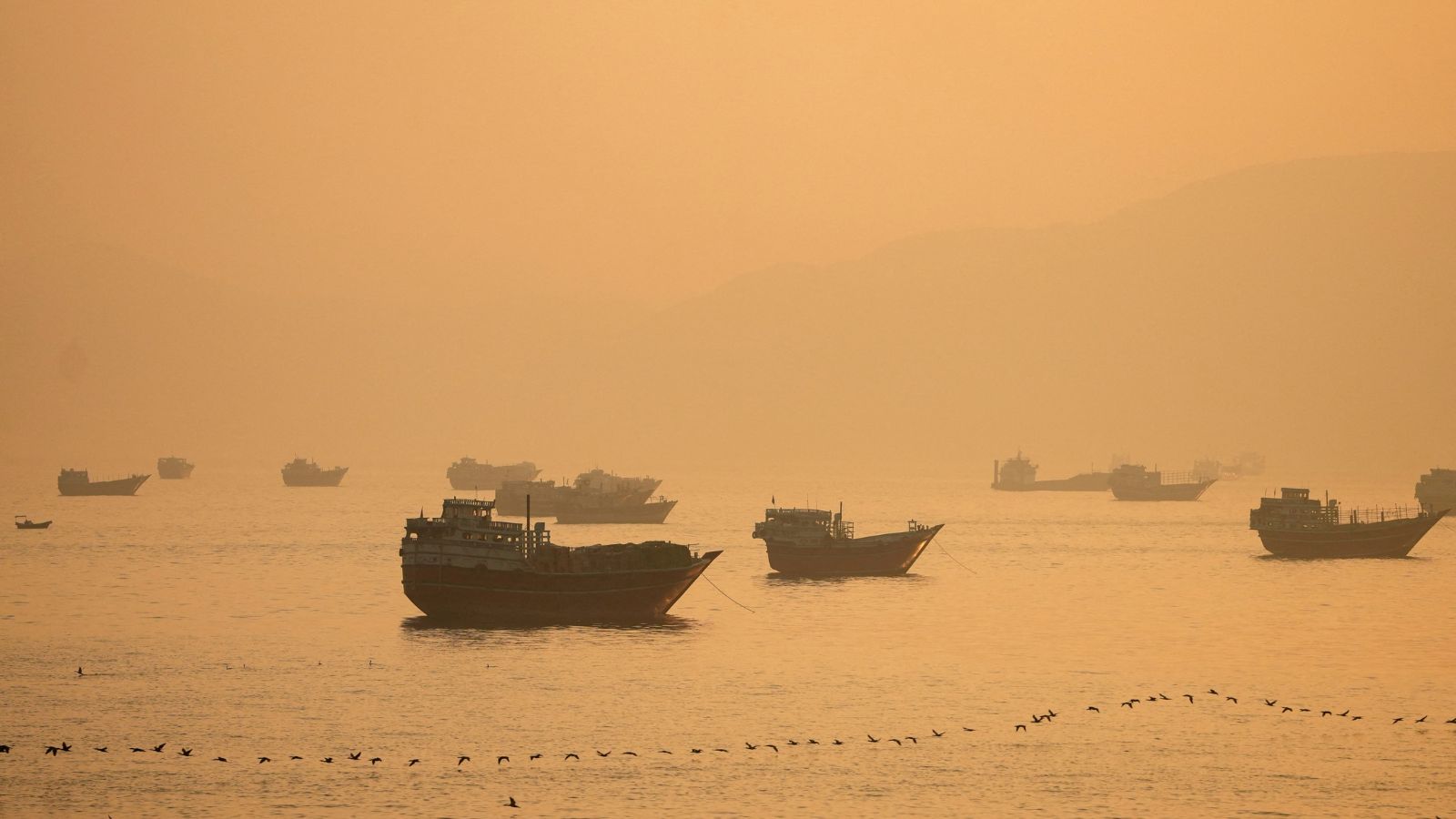
Once clear of the immediate strait, the tankers do not proceed directly to international destinations. Doing so would expose them to interdiction in open waters while laden with high-value cargo. Instead, they divert to two specific deepwater hubs: one situated off the coast of Fujairah (UAE) and the second near the port of Sohar (Oman).
At these coordinates, the smaller shuttle tankers pull directly alongside anchored Very Large Crude Carriers (VLCCs). The ship-to-ship transfer process is a prolonged technical vulnerability, requiring between 24 and 40 hours of continuous pumping side-by-side. During this window, the vessels are highly static and prone to collision or targeted drone strikes. Once the transfer concludes, the empty shuttle tankers cycle back through the strait to repeat the loop, while the fully loaded VLCCs—operating with legitimate cargo manifests that mask the immediate point of origin—sail toward international buyers.
The Cost Function of Covert Logistics
While this mass-shuttling operation successfully circumvents a hard geographic blockade, substituting conventional transit with an aggregated dark fleet model imposes severe economic and operational inefficiencies.
Compressed Operational Efficiency
A standard direct transit from a Gulf loading terminal to an international refinery maximizes the utilization rate of a VLCC. In contrast, the STS extraction architecture introduces a multi-tiered handling bottleneck. The requirement for smaller, agile shuttle tankers to navigate the strait creates a hard cap on throughput, dictated by the formula:
$$\text{Maximum Daily Throughput} = N \times C \times \eta$$
Where $N$ represents the number of active shuttle pairs, $C$ represents the mean volumetric capacity of the shuttle vessels, and $\eta$ represents the cyclical efficiency coefficient (factoring in the 24-to-40-hour transfer window and return transit time).
Because the operation peaked at 17 simultaneous pairs of ships transferring cargo, the infrastructure faced a structural ceiling. The physical limitations of mooring two massive vessels in open water during volatile sea states mean that throughput cannot scale linearly; it is fundamentally constrained by available secure anchorage space in Fujairah and Sohar.
Escalating Risk Profiles
The systemic trade-off of suppressing AIS transponders and running without navigation lights is an exponential increase in maritime collision probability. Standard merchant shipping relies on automated collision-avoidance systems to plot vectors. Operating heavy tankers at minimal distances in dark conditions eliminates the traditional safety margins required for vessels that require miles to alter course or come to a halt.
Furthermore, the operational security of the network is fragile. The downing of a U.S. Apache helicopter involved in the overwatch mission demonstrates that the operational envelope is continuously contested. Every kinetic interaction threatens to disrupt the thin line of commercial operators willing to accept these terms, as corporate risk compliance departments face escalating insurance premiums that can quickly render the entire covert supply chain financially unviable.
Strategic Realignment of Maritime Power
The adoption of these methods by a conventional superpower indicates a structural shift in global maritime strategy. Historically, dark fleet tactics—such as falsifying bills of lading, disabling transponders, and conducting mid-ocean ship-to-ship transfers—were the exclusive domain of heavily sanctioned states or non-state entities seeking to inject illicit product into legitimate markets.
The institutionalization of these exact protocols by the U.S. military to protect allied state-owned fleets reveals that the traditional rules of maritime freedom of navigation are insufficient during high-intensity regional conflicts. When international legal frameworks fail to guarantee passage through sovereign-adjacent waters, the preservation of global supply chains dictates the adoption of the adversary's logistics manual.
The immediate trajectory indicates that this STS network will expand in volume but degrade in safety. As long as the primary blockade persists, international tanker operators will continue to demand high premiums to participate in the NCAGS framework. The sustainability of the operation relies entirely on maintaining the absolute secrecy of the staging waypoints and ensuring that the rate of shuttle cycles outpaces the attrition or interdiction capabilities of coastal battery networks. The operational paradigm has definitively shifted from defending sea lanes to masking the traffic within them.