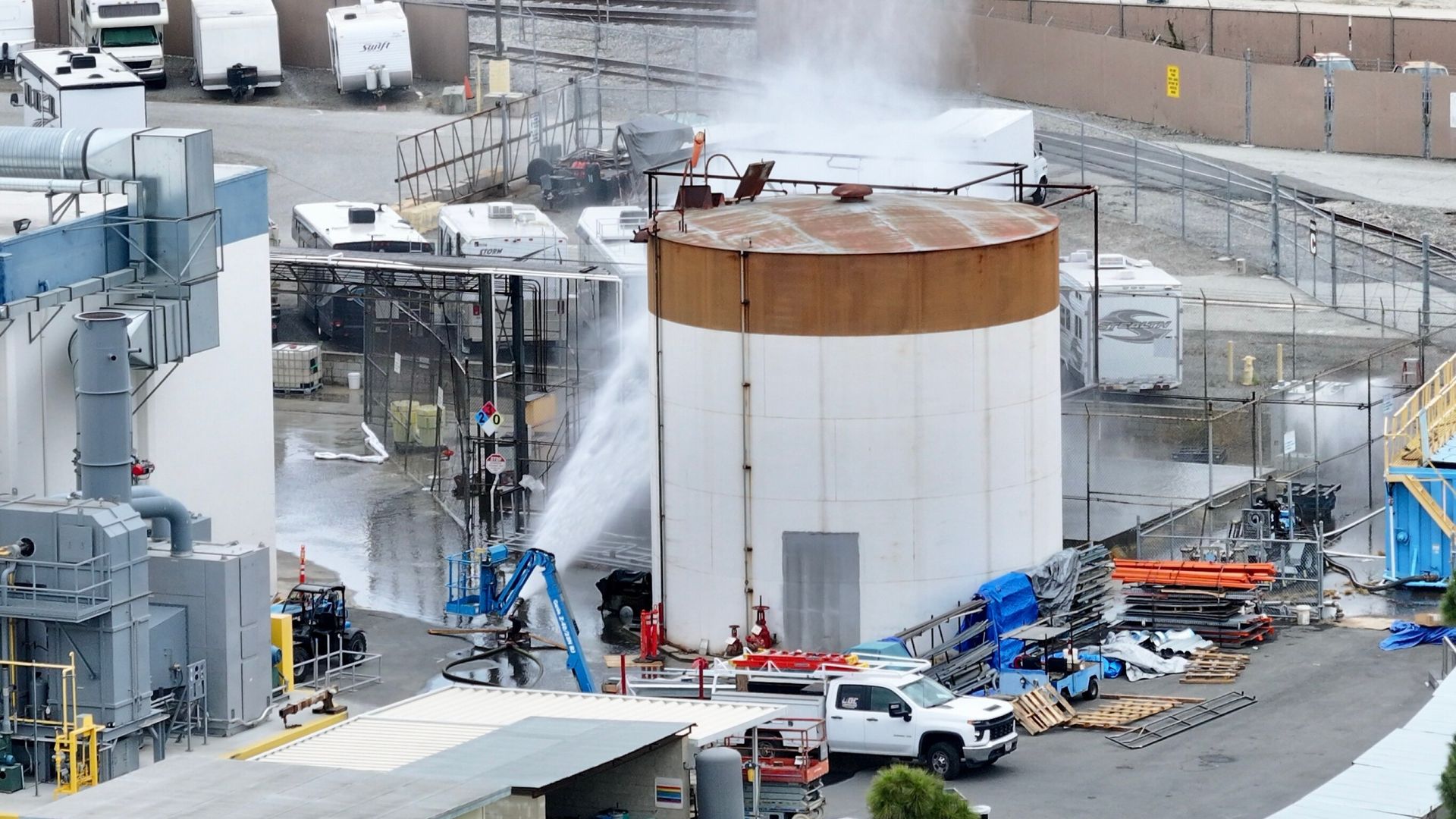
Corporate crisis management frequently fails when organizations isolate legal liability from operational throughput. When London-listed Melrose Industries established a $100 million compensation framework following a thermal event at a GKN Aerospace facility in Garden Grove, California, market analysts initially fixated on the headline liquidity drain. However, the economic reality of modern industrial manufacturing dictates that capital set aside for public compensation is rarely the primary driver of shareholder value destruction. Instead, the loss of operational capacity, fixed-cost absorption failures, and regulatory compliance latency dictate the true financial toll.
The incident at the California plant—triggered by a thermal anomaly in a chemical storage tank housing methyl methacrylate, an essential monomer in acrylic product manufacturing—forced an immediate local evacuation and subsequent plant throttling. While the physical containment protocols prevented structural breaches, injuries, or toxic leaks, the facility was forced to operate at half its capacity. This operational compression introduced a multi-variable economic strain that far outpaces simple settlement accounting. For an alternative look, consider: this related article.
The Mechanics of Throughput Depreciation
When a specialized manufacturing plant operates at fifty percent capacity, the corporate cost structure experiences a profound distortion. Fixed overhead costs, including facility leases, specialized engineering talent, and regulatory compliance maintenance, remain constant while unit output drops by half. For a facility contributing substantial baseline revenue to its parent organization, the resulting margin contraction manifests as a steady monthly cash burn.
The financial architecture of the GKN Aerospace event illustrates this mechanism clearly: Similar reporting on this trend has been provided by MarketWatch.
- Fixed facility overhead continues without interruption during partial shutdowns.
- Revenue generation drops in direct proportion to the volume restriction, yielding a monthly operational deficit.
- Pausing share buyback programs to preserve liquidity signals a defensive capital allocation strategy designed to protect solvency ratios over shareholder returns.
- Capital expenditure redirection toward facility decommissioning and infrastructure redesign introduces opportunity costs across broader corporate portfolios.
This dynamic demonstrates that industrial risk management requires accounting for lost velocity rather than just direct remediation. A production line running at reduced speed incurs invisible losses through unrecovered depreciation and delayed customer delivery schedules, which risk long-term tier-one supplier contracts.
Regulatory Closure Versus Civil Exposure
A critical error in evaluating industrial accidents is treating regulatory investigations and civil liabilities as a single risk pool. In the Garden Grove case, the Orange County District Attorney's Office officially closed its criminal investigation without filing charges, confirming that safety systems and emergency responses functioned within acceptable legal tolerances. Yet, closing a criminal inquiry does not neutralize financial exposure.
Civil exposure operates on a different economic continuum, governed by the volume of individuals affected rather than the presence of criminal negligence. With approximately 50,000 residents impacted by evacuation advisories, the establishment of a $100 million remediation fund represents an actuarial calculation designed to mitigate class-action friction.
The fund targets discrete economic variables:
- Temporary housing and lodging reimbursement for displaced demographics.
- Direct wage replacement for workers unable to access commercial zones during the perimeter lockdown.
- Logistics and transportation subsidies incurred during the emergency window.
- Administrative overhead associated with validating individual claims through a structured portal.
By ring-fencing these costs into a defined program, corporate leadership converts an open-ended legal liability into a capped financial liability. This separation of regulatory clearance from civil indemnification allows executive teams to provide forward-looking guidance to equity markets, restoring visibility to future cash flow projections.
Capital Allocation Under Crisis Constraints
The strategic response to large-scale industrial containment events exposes the fragility of corporate liquidity buffers. When unexpected exceptional costs materialize—such as the projected tens of millions in second-half operational adjustments—management teams must immediately triage capital deployment.
Share buyback programs are frequently the first lever adjusted. While pausing these programs protects corporate balance sheets, it alters the capital structure and depresses short-term equity valuations until operational normalization occurs. The timeline from partial shutdown to full operational recovery dictates whether a temporary industrial hiccup transforms into a permanent loss of market share. Phased return-to-service schedules, dependent on rigorous safety certifications and environmental testing, create an unavoidable ramp-up lag.
Organizations facing similar operational shocks must bypass superficial remediation and immediately deploy a three-phase recovery matrix: isolate the compromised asset class, ring-fence civil liabilities through structured compensation caps to eliminate litigation uncertainty, and front-load capital expenditures toward safety redundancy to accelerate regulatory sign-off. Capital preservation succeeds only when operational velocity is safely restored.