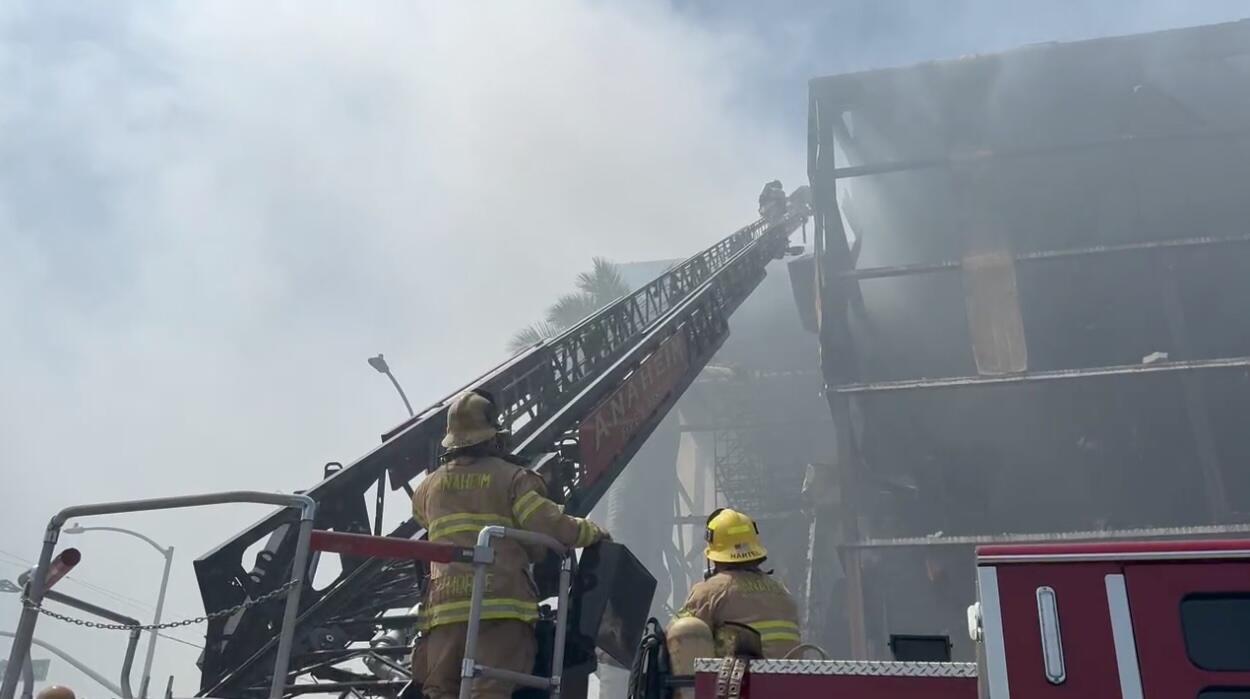
The containment of the June 17, 2026, structural failure at the Lineage Logistics facility in Boyle Heights reveals a systemic vulnerability in modern cold chain infrastructure. What began as a localized electrical event within a rooftop solar array rapidly evolved into a multi-day cascading emergency. This incident represents a specific class of industrial failure where architectural design, hazardous chemical payloads, and high-density combustible mass intersect to defeat standard municipal suppression strategies. To understand why a fire inside a 500,000-square-foot refrigerated warehouse can withstand 120 firefighters and aerial water drops for nearly a week, the incident must be broken down into its core mechanical, chemical, and structural variables.
The protracted nature of the Palos Fire is explained by three independent structural bottlenecks: the thermal insulation barrier, the refrigerant hazard envelope, and the mechanical collapse of the high-density racking infrastructure. Building on this idea, you can also read: The Oman Backchannel Illusion Why the Iran-US Memorandum is a Diplomatic Dead End.
The Tri-Partite Bottleneck of Refrigerated Facility Suppression
Standard industrial warehouse fires are typically suppressed via automatic overhead deluge systems or direct internal structural attacks. The Lineage Big Bear facility, built as a massive localized thermal envelope, presented an entirely different thermodynamic profile.
The Thermal Insulation Barrier
Cold storage facilities utilize thick envelopes of expanded polystyrene (EPS) or polyurethane foam sandwiched between corrugated steel panels to minimize thermal transfer. This design creates a highly efficient insulation barrier for refrigeration, but functions as a defensive bunker when an internal ignition occurs. Analysts at The New York Times have shared their thoughts on this trend.
Once fire breached the roof via the solar panel array, the foam insulation ignited. This created a concealed, self-sustaining burn layer shielded from external water application by the outer steel cladding. The insulation possesses high energy density and low thermal conductivity, meaning the fire smolders at extreme temperatures while remaining protected from direct suppression streams. Firefighters were forced to deploy heavy machinery and excavators to physically strip the external steel skin simply to expose the burning substrate, a process that mechanically extended the operational timeline by days.
The Refrigerant Hazard Envelope
The primary operational bottleneck during the initial 48 hours was the breach of an industrial anhydrous ammonia ($NH_3$) refrigeration line. Industrial cold storage units rely on ammonia due to its superior thermodynamic properties compared to synthetic refrigerants. However, anhydrous ammonia presents distinct hazards:
- Toxicity: It has a high affinity for moisture, reacting immediately with respiratory tracts, skin, and eyes to cause severe chemical burns.
- Flammability: While difficult to ignite in open air, it has a lower explosive limit (LEL) of approximately 15% to 28% by volume when confined within a structure.
The moment the line ruptured, internal offensive operations became impossible. The hazard envelope expanded, forcing the Los Angeles Fire Department (LAFD) to pull crews back from the building interior to prevent lethal exposure and potential secondary explosions. Suppression shifted exclusively to defensive exterior positions and water drops from helicopters—a tactic typically reserved for wildland-urban interface fires, not dense industrial zones.
Mechanical Collapse and Unstable Racking Topography
Cold storage warehouses optimize volume via ultra-dense vertical racking systems that hold millions of pounds of inventory. These racks are integrated deeply into the building's structural footprint.
As the fire compromised the roof trusses, the structural steel lost tensile strength and warped, causing a partial collapse of the roof onto the internal racks. The racking systems now act as a mechanical shield, preventing water from reaching the lower levels of burning Class A combustibles while simultaneously supporting thousands of tons of unstable, shifting roof debris. The interior became a highly unpredictable topography of physical hazards, completely ruling out human entry and forcing reliance on remote robotic reconnaissance units.
Measuring Environmental and Biological Cost Functions
The true impact of the Palos Fire extends beyond property destruction; it is measured through a complex environmental cost function driven by airborne particulate dynamics and a secondary biological hazard from inventory decomposition.
                  [Rooftop Solar Ignition]
                             │
                             ▼
               [Foam Insulation Burn (PM2.5)]
                             │
                             ▼
         ┌───────────────────┴───────────────────┐
         ▼                                       ▼
 [Low-Altitude Smolder]                [Ammonia Line Rupture]
         │                                       │
         ▼                                       ▼
[Microclimate Transport]                [Defensive Retreat]
(South Pasadena/Pasadena)               (Exterior Attacks Only)
         │                                       │
         └───────────────────┬───────────────────┘
                             ▼
               [Inventory De-Refrigeration]
                             │
                             ▼
               [85M lbs Biohazard Vector]
Airborne Particulate Matter (PM2.5) Dispersal
The smoke plume generated by the burning foam insulation and organic inventory consists primarily of PM2.5—particulate matter with an aerodynamic diameter less than 2.5 micrometers. These particles bypass the upper respiratory defenses and penetrate deep into pulmonary alveoli, translocating directly into the bloodstream.
During the middle phase of the incident, meteorological conditions shifted. A drop in wind velocity coupled with an overnight thermal inversion layer prevented the smoke from rising and dispersing into the upper atmosphere. Instead, a low-altitude smolder kept the toxic plume pinned close to ground level. Shifting lateral winds transported this dense particulate haze northeast, over downtown Los Angeles and directly into residential microclimates including South Pasadena, San Marino, and Highland Park. Ground-level air monitoring sensors registered a sharp transition from "moderate" to "unhealthy" AQI thresholds, prompting extended particle pollution advisories from the South Coast Air Quality Management District (AQMD).
The 85-Million-Pound Biological Vector
The final, and perhaps most complex, phase of the cost function involves the inventory itself. The facility contained approximately 85 million pounds of frozen food items, including commercial volumes of poultry, beef, pork, and bread products.
When the structural integrity was compromised and the power grid isolated, the refrigeration cycle ceased. Although the thick foam insulation initially held internal temperatures at a localized equilibrium near 45 degrees Fahrenheit, the continuous thermal energy from the smoldering fire has initiated a mass thaw.
This volume of unmitigated organic matter introduces a significant biohazard vector. As anaerobic bacterial decomposition accelerates within the sealed, warm environment, it generates methane ($CH_4$) and hydrogen sulfide ($H_2S$) gases, alongside liquid organic effluent. The remediation process cannot begin until the fire is declared 100% extinguished; however, the longer the organic mass decays, the more dangerous the interior environment becomes for clean-up crews due to atmospheric toxicity and bio-contamination.
Operational Lessons for Urban Logistics Infrastructure
The Boyle Heights incident exposes a profound mismatch between standard municipal fire suppression capabilities and modern, high-density industrial logistics infrastructure. To mitigate identical risks in future developments, three core modifications must be integrated into industrial building standards.
First, solar array isolation mechanics must be decoupled from the structural roof membrane. Installing vast photovoltaic fields directly on top of highly combustible foam insulation creates an unmanageable ignition risk. Future designs require non-combustible thermal breaks between the roof surface and solar framing.
Second, industrial refrigeration systems must feature automated multi-point isolation valves. In the event of a localized structural breach, the system must automatically isolate the ammonia payload into decentralized, fortified holding vessels, preventing the entire chemical volume from venting into an active fire zone.
Finally, structural engineering models must account for "bunker-style" access. If a building is designed to completely seal out the external environment for thermal efficiency, it must include dedicated, blast-resistant ventilation ports that first responders can actuate from the exterior to exhaust toxic smoke and heat without needing to physically dismantle the building's shell.
The Palos Fire is not an isolated accident; it is a blueprint for the structural vulnerabilities inherent in the concentrated urban supply chains of modern cities. Until building codes reflect the true chemical and mechanical realities of high-density cold storage, municipal fire departments will remain poorly equipped to handle the unique physics of the smoldering industrial bunker.

/https://tf-cmsv2-smithsonianmag-media.s3.amazonaws.com/filer/c6/97/c697b065-e0bd-4970-81ea-819779296b91/u765404inp.jpg)
