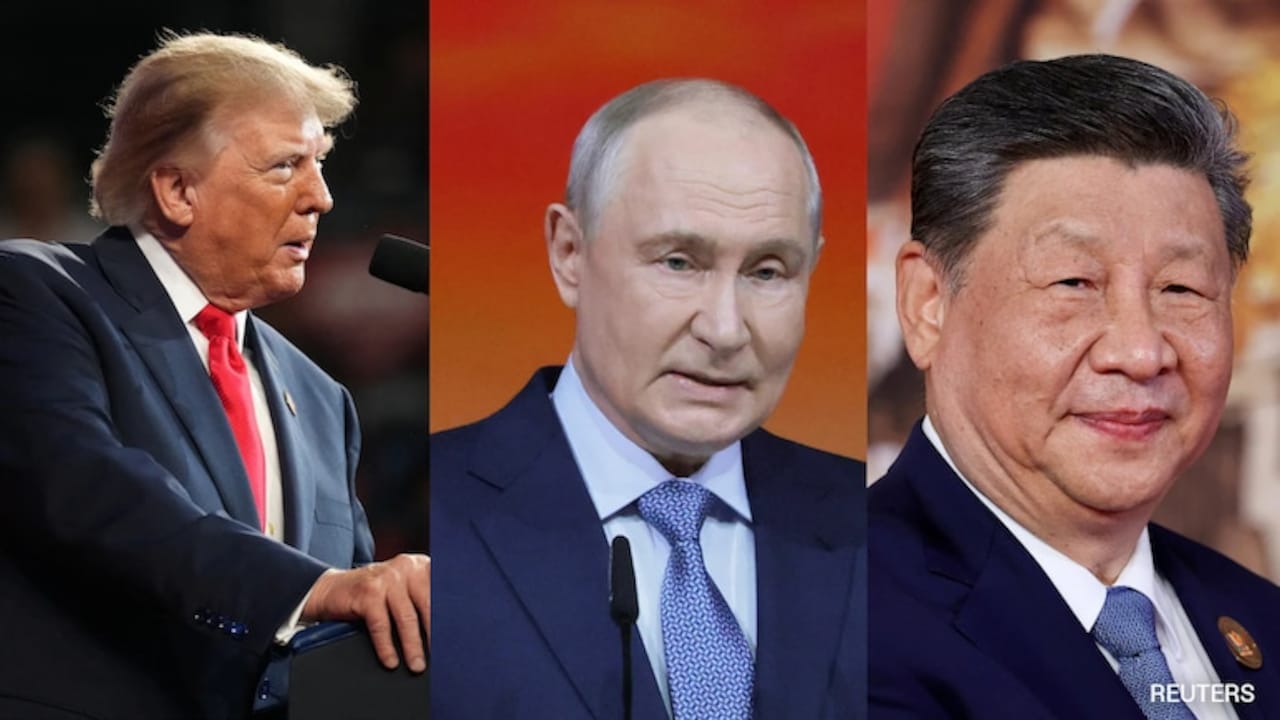
The first-ever trilateral summit between U.S. President Donald Trump, Chinese President Xi Jinping, and Russian President Vladimir Putin in Shenzhen represents an exercise in diplomatic theater rather than a structural realignment of the international order. Conventional reporting frames the 90-minute meeting on the sidelines of the Asia-Pacific Economic Cooperation (APEC) forum as a historic breakthrough—invoking comparisons to the 1945 Yalta Conference. This framing confuses diplomatic optics with binding geopolitical commitments. A rigorous operational audit of the summit’s mechanics, the resulting four-point communiqué, and the divergent incentive structures of Washington, Beijing, and Moscow demonstrates that while the optics alter the diplomatic baseline, the underlying strategic conflicts remain unresolved.
To understand what actually occurred in Shenzhen, analysts must separate theatrical signaling from enforceable statecraft. When three nuclear-armed powers convene without a pre-negotiated treaty framework, the primary output is perception management. Each leader entered Kylin Villa with distinct domestic and international utility functions, using the trilateral stage to extract asymmetric political capital while conceding zero core national interests.
The Asymmetry of Strategic Incentives
In multi-party negotiations, durable agreements require a Zone of Possible Agreement (ZOPA) where the minimum acceptable terms of all parties overlap. Across the primary theaters of friction—Eastern Europe, the Taiwan Strait, nuclear force posture, and bilateral trade—no such overlap exists between the United States and the Sino-Russian entente. Instead, the summit functioned as a market for unilateral political gains.
Beijing’s Role as Convener and Arbiter
For Xi Jinping, hosting the inaugural trilateral summit on Chinese soil—specifically in Shenzhen, the symbolic epicenter of China’s technological and economic modernization—accomplished a primary objective of Chinese grand strategy: positioning Beijing as the indispensable diplomatic hub of a multipolar world.
- Visualizing Multipolarity: By placing the leaders of the United States and Russia at a table under Chinese auspices, Beijing visually negated the post-Cold War architecture of American unipolarity.
- Diluting Bilateral Pressure: Washington has spent years attempting to isolate Beijing on technology export controls and trade imbalances, while pressuring China over its dual-use industrial support for Russia’s defense sector. Expanding the format from a U.S.-China bilateral to a three-way summit allowed Xi to diffuse bilateral friction inside a broader, abstract discussion of global governance.
- Protecting Export Markets: Facing domestic economic headwinds and a looming January 10, 2027 expiration of the U.S.-China trade truce, Beijing needed a diplomatic circuit breaker to stall punitive U.S. tariff escalations without altering its state-subsidized industrial model.
Moscow’s Escape from Diplomatic Isolation
Vladimir Putin achieved the highest immediate return on investment with the lowest structural concession. Since the full-scale invasion of Ukraine in 2022, Western strategy has relied on diplomatic ostracization and economic sanctions to impose costs on the Kremlin.
Standing alongside the U.S. and Chinese presidents as an equal co-architect of global security shattered that isolation in real time. Crucially, the trilateral format created a two-against-one structural dynamic regarding European security. Because Beijing and Moscow share a foundational opposition to NATO expansion and Western alliance networks—reaffirmed in their May 2026 joint statement—Putin gained a forum to frame the war in Ukraine through a lens largely endorsed by his host, bypassing European and Ukrainian stakeholders entirely.
Washington’s Transactional Calculus
Donald Trump approached the Shenzhen meeting through a transactional framework that prioritizes direct leader-to-leader engagement over institutional alliances. The U.S. administration’s calculus rested on three operational assumptions:
- Direct Access Bypasses Bureaucratic Inertia: Trump’s opening assertion that peace cannot be forged by declining dialogue reflects a belief that personal rapport with authoritarian counterparts can unlock concessions that traditional diplomatic channels fail to secure.
- Triangular Wedge Strategy: By engaging Moscow and Beijing simultaneously, Washington sought to test whether diplomatic normalization could incentivize Russia and China to restrain secondary actors—specifically Iran regarding nuclear proliferation and maritime security in the Strait of Hormuz.
- Domestic Economic Deliverables: Ahead of the December 2026 G20 summit in Miami, the White House prioritized visible trade and agricultural purchase commitments to appease domestic constituencies, even at the risk of appearing as a demandeur on tariffs and export controls.
Deconstructing the Four-Point Communiqué
The gap between historic rhetoric and operational reality is clearest in the text of the U.S.-Russia-China Heads of State Declaration toward Peace. In diplomatic analysis, what is omitted from a joint communiqué is more diagnostic than what is included. The Shenzhen declaration contains zero actionable mechanisms regarding Ukraine, Taiwan, semiconductor export controls, or bilateral tariffs. Instead, the three powers retreated to four areas of lowest-common-denominator consensus.
1. Nuclear Risk Reduction vs. Arms Control
The declaration reaffirms the 1985 Reagan-Gorbachev formulation that a nuclear war cannot be won and must never be fought, committing the three states to a dialogue on reducing nuclear risks and preventing proliferation.
Analytical rigor requires distinguishing between risk reduction and arms control. Following the expiration of the New START treaty nine months earlier, the United States and Russia operate without legally binding bilateral caps on deployed strategic warheads for the first time in over half a century. Simultaneously, China is executing a rapid expansion of its nuclear silo fields and delivery systems to achieve strategic parity.
- Why Arms Control Stalled: China refuses to enter trilateral numerical cap negotiations while its arsenal remains quantitatively smaller than those of the U.S. and Russia.
- What Risk Reduction Actually Means: Committing to dialogue allows Beijing to appear responsible on the global stage while continuing its force buildup unchecked. At best, this track yields crisis communication hotlines or missile launch notification protocols—useful operational guardrails, but structurally distinct from verifiable warhead reductions.
2. Sovereign Immunity and Institutional Pushback
In a striking convergence of executive self-interest, the three leaders explicitly condemned the International Criminal Court (ICC) and similar bodies, asserting that state consent and the immunities of state officials must not be breached.
This clause represents pure political alignment rather than geopolitical compromise. None of the three nations is a state party to the Rome Statute. Putin faces an active ICC arrest warrant over the deportation of Ukrainian children, while Washington has repeatedly clashed with the court over investigations into U.S. and allied personnel. By codifying joint opposition to supranational judicial jurisdiction, the three great powers signaled a shared preference for a Westphalian order in which sovereign executives are insulated from external legal accountability.
3. United Nations Security Council Reform
The communiqué pledges that the three permanent members of the UN Security Council (P5) will work to reform the institution to better respond to global challenges. This language is deliberately hollow. Structural UN reform requires amending the UN Charter, which is subject to the veto of every P5 member. Neither Washington, Beijing, nor Moscow will surrender its veto power or dilute its institutional primacy. References to UN reform serve primarily as diplomatic signaling to the Global South—allowing the three powers to posture as champions of modernized multilateralism without altering the distribution of voting power.
4. Refined Petroleum Supply and Energy Stability
The commitment to increase the production and supply of refined petroleum products reflects a shared sensitivity to global inflation and energy price volatility.
- For the United States: Keeping global fuel prices suppressed is critical to domestic inflation management.
- For Russia: Maintaining export volumes of refined products and crude oil—often routed through shadow fleets and Asian refineries—is the primary fiscal lifeline funding its state budget and military expenditure.
- For China: As the world’s largest crude importer and a major refining hub, stable feedstock flows and predictable margins protect industrial output.
This clause codifies existing market behavior rather than establishing a new supply cartel. It signals that Washington will not aggressively disrupt global energy supply chains to enforce sanctions if doing so triggers domestic price spikes.
The Structural Blind Spots of the Yalta Analogy
Mainstream commentary frequently compares a U.S.-Russia-China summit to the 1945 Yalta Conference, where Franklin D. Roosevelt, Winston Churchill, and Joseph Stalin partitioned post-war spheres of influence. Applying the Yalta model to 2026 produces severe analytical errors because three structural variables have fundamentally changed.
First, Yalta was a post-war settlement; Shenzhen occurred mid-conflict. In February 1945, the military defeat of Germany was an imminent certainty, and Allied armies physically occupied the territories being negotiated. In late 2026, active kinetic wars are ongoing in Ukraine and the Middle East, while economic and technological decoupling between the U.S. and China is accelerating. You cannot partition spheres of influence when the military and economic balances of power are still actively contested.
Second, middle powers possess independent agency and veto capacity. In 1945, Europe and East Asia were devastated, leaving the superpowers with a near-monopoly on military and economic decision-making. Today, European Union states, Ukraine, Japan, South Korea, Taiwan, and Gulf states possess substantial economic weight, advanced military capabilities, and independent political wills. Even if Washington, Beijing, and Moscow agreed on a settlement framework for Eastern Europe or the Persian Gulf, they lack the unilateral enforcement mechanisms to compel regional actors to comply—a reality underscored by Tehran’s immediate rejection of external deal-making following U.S. claims of trilateral alignment on Iran.
Third, the Sino-Russian alignment is asymmetric and structural, not malleable. Cold War triangular diplomacy—specifically the 1972 Nixon-Mao opening—succeeded because the Soviet Union and China were hostile adversaries engaged in border skirmishes, allowing Washington to exploit the Sino-Soviet split. In 2026, China and Russia share a deep structural alignment rooted in their mutual desire to erode U.S. alliance networks and financial dominance. Attempting to peel Moscow away from Beijing through summitry ignores Russia’s overwhelming economic dependence on Chinese industrial goods, microelectronics, and energy markets.
Operational Limitations of Summit-Driven Statecraft
Relying on high-profile trilateral summits to manage great-power competition carries specific operational risks that degrade strategic positioning over time:
- Concession Front-Loading: Authoritarian systems are structurally insulated from short-term electoral cycles and can extract tangible diplomatic legitimacy—such as state visits, high-level photo opportunities, and paused sanctions—upfront, while delaying substantive policy changes indefinitely.
- Alliance Erosion: When the United States engages in closed-door great-power consultations without prior coordination with treaty allies in Europe and the Indo-Pacific, it triggers hedging behavior. Allies such as Japan, South Korea, Poland, and Germany calculate that U.S. security guarantees are becoming conditional, accelerating debates over indigenous nuclear proliferation and strategic autonomy.
- Ambiguity as a Destabilizer: When leaders issue vague communiqués followed by contradictory unilateral readouts—such as U.S. Treasury officials claiming Sino-Russian agreement on Iran while Beijing and Moscow remain silent—it creates dangerous misperceptions regarding red lines and deterrence commitments.
Strategic Execution Path for Western Policymakers
Because symbolic summitry cannot resolve zero-sum disputes over territory, technological supremacy, and alliance architecture, strategic planning must shift from episodic leader-level theater to continuous structural leverage.
- Anchor Diplomacy to Binding Deadlines: Treat the December 14–15, 2026 G20 summit in Miami and the January 10, 2027 expiration of the U.S.-China trade truce not as venues for broad declarations, but as hard enforcement gates. Any extension of tariff relief or export control pauses must be conditioned on verifiable, quantifiable benchmarks—such as measurable reductions in Chinese dual-use component exports to Russian defense entities—rather than rhetorical commitments.
- Institutionalize Allied Co-Creation: Before entering subsequent trilateral or bilateral engagements with Beijing and Moscow, Washington must establish unified negotiating baselines with the G7, NATO, and Indo-Pacific treaty allies. Demonstrating that U.S. economic and security leverage is backed by a synchronized coalition eliminates Beijing’s and Moscow’s ability to exploit transatlantic and transpacific divisions.
- Separate Nuclear Guardrails from Political Linkage: Pursue technical, military-to-military nuclear risk reduction channels—specifically missile launch notifications and crisis deconfliction protocols—as standalone operational necessities, while maintaining offensive force modernization and allied extended deterrence to compel Beijing into substantive arms control negotiations.