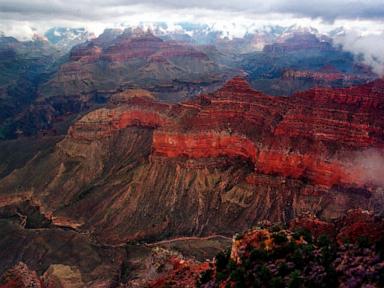
The death of three hikers within a compressed timeframe inside the Grand Canyon highlights a lethal intersection of inverted topography, thermodynamic human failure, and miscalculated environmental resistance. Standard backcountry safety narratives treat heat as a uniform regional variable. In deep canyon environments, heat functions as a dynamic, compounding trap where traditional survival heuristics fail.
To analyze these fatalities rigorously, the environmental risk must be separated into three distinct components: localized atmospheric mechanics, physiological thermal regulation failure, and operational rescue bottlenecks. You might also find this connected article interesting: The Broken Postpartum System Behind the Lindsay Clancy Tragedy.
The Inverted Topography Hazard
Most geographic environments exhibit a standard lapse rate where temperature decreases with elevation. The Grand Canyon operates on a severe structural inversion. The South Rim sits at approximately 7,000 feet above sea level, while the canyon floor drops to 2,400 feet. This 4,600-foot vertical drop creates a hyper-localized microclimate governed by adiabatic compression.
As air sinks into the canyon, atmospheric pressure increases. This compresses the air mass, forcing it to gain thermal energy at a dry adiabatic lapse rate of roughly 5.5°F per 1,000 feet of descent. A manageable 85°F at the trailhead on the rim systematically transforms into a punishing 110°F or higher at the Colorado River base. As discussed in detailed reports by WebMD, the results are worth noting.
[Rim Trailhead: 7,000 ft / 85°F]
       \
        \  Adiabatic Compression (+5.5°F per 1,000 ft)
         \
          [Canyon Floor: 2,400 ft / 110.3°F]
This topographical structure creates a psychological trap. The easiest portion of the transit occurs during the morning descent when temperatures are lowest and physical exertion is minimal. The maximum physical workload—ascending thousands of vertical feet—is deferred to the latter half of the itinerary, precisely when solar radiation peaks and ambient temperatures maximize.
Thermal massing worsens this effect. The canyon's dense sandstone and shale walls act as massive solar batteries, absorbing shortwave radiation throughout the day and re-radiating it as longwave infrared heat. Hikers do not just contend with air temperature; they are trapped in a radiant convective oven where the rock walls themselves project heat long after the sun shifts.
The Kinetic Thermodynamics of Human Overheating
Human thermal equilibrium relies on a strict heat balance equation where metabolic heat production must equal environmental heat dissipation. When dissipation mechanisms fail, core body temperature breaches the critical 104°F (40°C) threshold, initiating Exertional Heat Stroke (EHS) and cellular denaturation.
Heat Balance Equation:
S = M ± R ± C - E

Where:
S = Rate of heat storage (Must be 0 for equilibrium)
M = Metabolic heat production (Escalates during steep ascent)
R = Radiant heat exchange (High due to canyon walls)
C = Convective heat exchange (Hot air currents)
E = Evaporative cooling capacity (The primary failure point)
During a steep canyon ascent, metabolic heat generation increases by an order of magnitude. A hiker ascending a 15% grade with a backpack generates between 500 to 800 watts of internal heat. To prevent core temperatures from rising to lethal levels, the body relies almost exclusively on the evaporation of sweat.
Evaporative cooling operates under a strict physical constraint governed by vapor pressure differentials. When ambient temperatures exceed skin temperature (typically around 95°F), heat transfer via conduction and radiation reverses direction. The environment begins pumping heat into the body. At this point, evaporation becomes the sole operational mechanism to prevent systemic failure.
The evaporation bottleneck manifests via two distinct vectors:
- Dehydration and Stroke Volume Collapse: To facilitate sweating, the autonomic nervous system shunts blood flow away from internal organs to the cutaneous vessels near the skin. This requires a massive increase in cardiac output. As fluid is lost through sweat without immediate, metered replacement, blood plasma volume drops. The heart can no longer maintain adequate stroke volume to simultaneously cool the skin and perfuse working muscles. The system experiences cardiovascular collapse.
- The Hyponatremia Paradox: A critical failure mode among backcountry travelers is overconsumption of plain water without adequate sodium replacement. This triggers Exercise-Associated Hyponatremia (EAH), a rapid dilution of blood sodium levels. The osmotic balance shifts, forcing water into brain cells and causing cerebral edema. The symptoms—confusion, lethargy, and loss of motor control—mirror simple exhaustion, leading individuals to consume more water, accelerating neurological shutdown.
Wilderness Extraction Bottlenecks
The transition from a heat-related illness to a fatality is ultimately determined by the latency period between systemic failure and active cooling interventions. In remote wilderness sectors, this timeline is dictated by geography and thermodynamic limitations on aviation.
When an individual collapses on an interior canyon trail like the Bright Angel or South Kaibab loops, the response time of Search and Rescue (SAR) teams is constrained by a factor known as density altitude. High ambient temperatures decrease air density, which directly reduces helicopter rotor efficiency and engine performance.
During extreme heat events, medical evacuation helicopters face strict payload limits. They cannot lift off from the canyon floor with a full crew, fuel load, and patient simultaneously. Rescue operations are routinely delayed because aircraft must wait for temperatures to drop to achieve the necessary lift capacity, or teams must be inserted on foot, extending the exposure timeline of the patient past the critical golden hour of heat stroke survival.
Operational Frameworks for Extreme Transit
Mitigating mortality in high-altitude desert environments requires replacing static survival advice with a dynamic operational risk framework. Relying on arbitrary fluid metrics like "one gallon of water per person" is insufficient because it treats water consumption as an isolated variable independent of metabolic output and ambient thermal load.
A rigorous approach to extreme backcountry travel demands a three-tier mitigation strategy:
1. Thermal Window Zoning
Itinerary planning must be dictated by the thermal clock rather than distance milestones. Operational shutdown must occur between 10:00 AM and 4:00 PM within the inner canyon. During these hours, metabolic output must drop to zero in shaded areas near water sources, regardless of trip progress.
2. Micro-Rationing of Osmotic Fluids
Fluid intake must be linked directly to sodium intake to prevent the hyponatremia bottleneck. The maximum absorption rate of the human gut is roughly 1 liter of fluid per hour. Consumption exceeding this rate during heavy exertion does not improve hydration; it creates gastric distress and accelerates systemic electrolyte dilution. Fluids must contain a minimum concentration of 500–700 mg of sodium per liter to maintain plasma stability.
3. Exertional Ceiling Clamping
Hikers must artificially limit their ascent velocity to keep their heart rate well below the ventilatory threshold. Pushing into high cardiovascular zones drastically increases metabolic heat production while accelerating dehydration. When the ambient air temperature exceeds 100°F, pacing must be reduced by 50% relative to sea-level performance to compensate for the compromised convective cooling capacity of the atmosphere.