The collapse of the June 17 ceasefire between the United States and Iran is not a failure of diplomacy, but the logical consequence of a structural contradiction regarding maritime jurisdiction in the Strait of Hormuz. The latest kinetic exchange—manifested in U.S. Central Command (CENTCOM) precision strikes against approximately 90 Iranian targets and subsequent Iranian retaliatory strikes against U.S. assets in Bahrain and Kuwait—exposes a critical misalignment in how both nations define the cost functions of deterrence. While mainstream reporting focuses on the immediate choreography of explosions in southern Iran, a clinical analysis reveals a deeper, dual-track targeting strategy designed to systematically degrade Iran’s coastal anti-access/area-denial (A2/AD) capabilities while fracturing its internal logistics.
The Dual-Track Degradation Model
The kinetic operations executed by CENTCOM targeted specific nodes designed to alter the operational equilibrium in the Persian Gulf. This intervention operated on two distinct axes: tactical maritime suppression and strategic logistical disruption.
Axis 1: Tactical Suppressive Striking
CENTCOM deployed precision munitions against a dense network of coastal assets across southern Iran, specifically concentrated near the port cities of Bandar Abbas, Sirik, Bushehr, and Qeshm Island. The structural targeting matrix reveals an intent to achieve complete electromagnetic and kinetic dominance over the Strait of Hormuz by neutralizing specific Iranian capabilities:
- Coastal Surveillance and Integrated Air Defense Systems (IADS): Early warning radar arrays and surface-to-air missile (SAM) sites were systematically targeted to create clean vectors for subsequent penetration corridors.
- Anti-Ship Cruise Missile (ASCM) Batteries: Fixed and mobile launch sites overlooking the shipping lanes were eliminated to reduce the immediate threat profile to commercial and naval vessels transiting the chokepoint.
- Unmanned Aerial Vehicle (UAV) Infrastructure: Drone launch platforms and localized storage facilities were neutralized to impair Iran’s low-cost asymmetric projection and reconnaissance capabilities.
Axis 2: Strategic Logistical Disruption
Simultaneously, U.S. operations expanded beyond purely military assets into high-value infrastructure nodes. Iranian state media verified the destruction of critical railway bridges in northeastern regions, notably on the transit lines leading to Mashhad.
Tehran has categorized these actions as a deliberate attempt to disrupt the state-mandated funeral proceedings for the late Supreme Leader Ali Khamenei. The objective reality, however, points to a highly calculated economic impact. The targeted railway infrastructure serves as a primary geostrategic artery linking Iranian supply lines to China, its foremost economic and trade partner. Severing these logistical corridors introduces a severe bottleneck into Iran's land-based supply chains, artificially compounding the friction generated by maritime blockades.
The Collision of Disparate Maritime Doctrines
The core driver of this escalation loop is an asymmetric interpretation of the June 17 Memorandum of Understanding (MoU). This structural friction operates through a distinct cause-and-effect chain.
[Iran's Legal Interpretation: Sovereignty Over Transit]
                      │
                      ▼
[Asymmetric Maritime Enforcement (Levying Fees / Kinetic Inspections)]
                      │
                      ▼
[Interdiction of Commercial Shipping (3 Tankers Hit)]
                      │
                      ▼
[U.S. Deterrence Function Activated (CENTCOM Suppressive Strikes)]
Iran views its geographic positioning as granting it absolute regulatory authority over the Strait of Hormuz. Under this doctrine, the interim ceasefire did not strip Tehran of its right to manage, inspect, or levy transit fees on commercial shipping lanes. When Iran acted upon this assumption by deploying the Islamic Revolutionary Guard Corps (IRGC) to intercept and strike three commercial tankers that allegedly ignored localized warnings, it triggered the U.S. freedom of navigation doctrine.
The U.S. strategic framework views the unilateral imposition of transit authority by Iran as an existential threat to global energy security. Because roughly 20% of global liquefied natural gas (LNG) and crude oil flows through this narrow passage, the U.S. navy operates on an unyielding principle: any kinetic interference with commercial shipping mandates an immediate, asymmetric punitive response. The subsequent CENTCOM strikes were designed to re-establish the high financial and material cost of maritime interdiction, directly challenging the assumptions of Iranian negotiators like Parliament Speaker Mohammad Bagher Qalibaf.
Asymmetric Retaliation and Geopolitical Friction
The Iranian counter-strike model demonstrates a clear understanding of regional vulnerability. Rather than engaging in a direct, symmetrical naval battle against superior U.S. carrier strike groups, the IRGC deployed a swarm-based asymmetric response targeting U.S. forward operating bases in neighboring Gulf States.
The Regional Target Matrix
By launching missile and drone salvos against 85 U.S. military sites, including the Sheikh Isa airbase in Bahrain and logistics hubs in Kuwait, Tehran intentionally shifted the geopolitical risk onto America's regional allies. This strategy forces host nations to balance the domestic and defensive costs of harboring U.S. personnel against the security guarantees provided by Washington. The activation of Kuwaiti and Bahraini air defense systems highlights the systemic vulnerability of regional logistical footprints to sustained asymmetric saturation attacks.
The Red Line Shift
Furthermore, Washington’s public rhetoric has fundamentally altered the parameters of deterrence. By openly threatening to target civilian infrastructure, specifically electricity grids, desalination plants, and the critical oil production facilities on Kharg Island, the U.S. executive branch is shifting from a policy of proportional military response to a doctrine of total economic paralysis.
Structural Vulnerabilities in Global Energy and Supply Lines
The immediate operational reality for global markets is characterized by severe friction. The escalating conflict introduces three primary structural vulnerabilities:
- Chokepoint Kinetic Risk: The Strait of Hormuz cannot be bypassed for the vast majority of Persian Gulf hydrocarbon exports. Commercial shipping lines face exponential increases in insurance premiums, rendering transit economically unfeasible for non-state-backed fleets.
- Logistical Rigidity: The degradation of domestic rail networks within Iran limits the state's capacity to pivot toward Eurasian land routes, forcing reliance on vulnerable domestic ports like Sirik and Bandar Abbas, which are already within the active kinetic envelope of U.S. forces.
- Allied Defensive Strain: Forward-deployed U.S. assets are structurally dependent on localized air defense systems (such as Patriot and terminal high-altitude area defense arrays). A prolonged, high-rate-of-fire asymmetric attack from Iran risks depleting interceptor stockpiles faster than supply chains can replenish them.
The theater has transitioned beyond a localized border dispute into a highly volatile war of attrition. The operational matrix demands that commercial maritime operations and regional logistics providers immediately pivot to contingency routing. Navigating the Persian Gulf under the current paradigm requires explicit state-backed security details or absolute avoidance of the Strait of Hormuz until a verifiable, structural realignment of maritime jurisdiction is agreed upon by both sovereign actors.
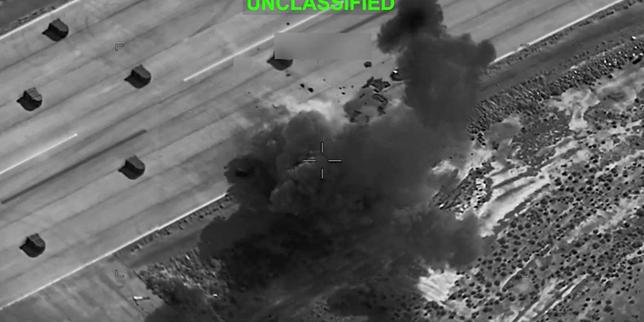
U.S. strikes southern Iran
This broadcast outlines the immediate tactical developments and verified reports of explosions across southern Iran following the breakdown of the maritime ceasefire.