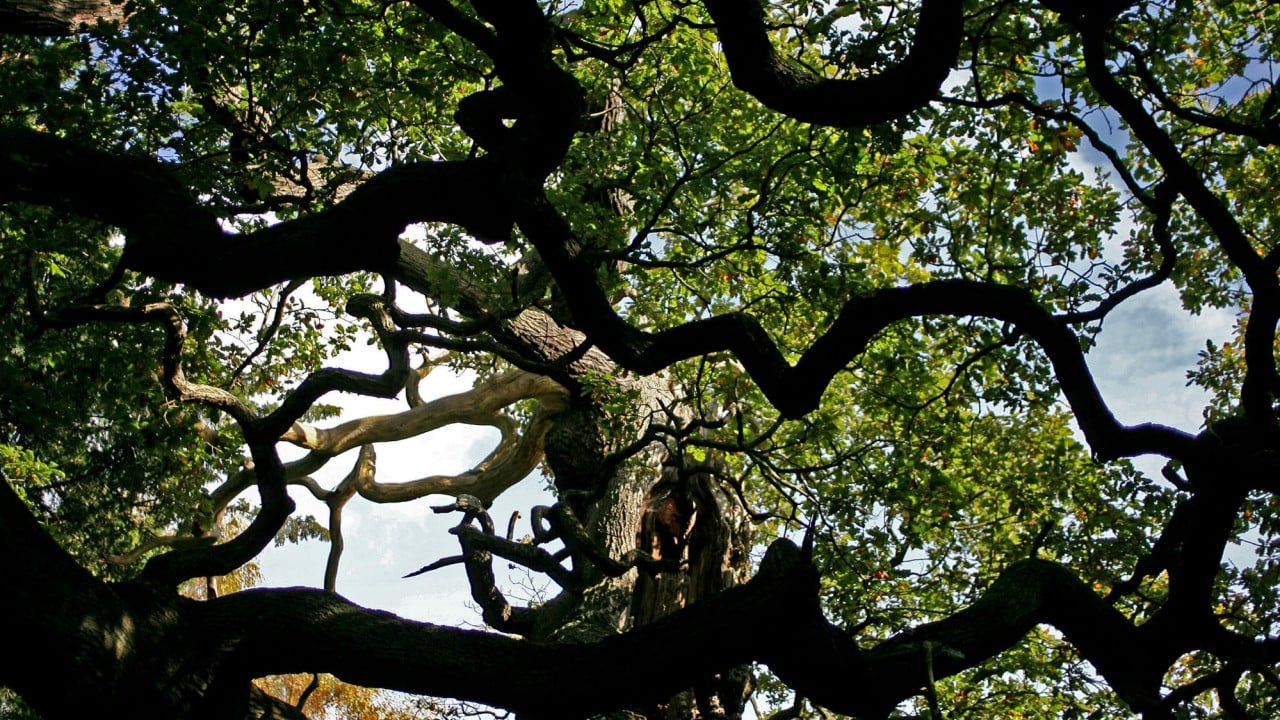
The biological cessation of the Major Oak—the 1,200-year-old English oak ($Quercus robur$) in Sherwood Forest historically linked to the Robin Hood legend—provides a definitive case study in how anthropocentric management directly accelerates ecological failure. The announcement by the Royal Society for the Protection of Birds (RSPB) that the organism failed to produce leaves or buds confirms metabolic collapse. While mainstream reporting attributes this death to a vague combination of old age and global heating, a rigorous structural analysis reveals a more complex cause-and-effect matrix. The tree was systematically compromised by three compounding vectors: acute subterranean soil compaction, systemic physiological disruption induced by structural bracing, and escalating macro-climate thermal stress.
Understanding the mechanisms behind this collapse requires breaking down the core vulnerabilities that sealed the organism’s fate.
The Tri-Axe Matrix of Arboreal Decline
The decline of a veteran tree does not occur via isolated incidents but through a compounding feedback loop where structural interventions and environmental stressors degrade the organism's baseline metabolic capacity.
[Historical Tourism] ----> Extreme Soil Compaction ----> Root Asphyxiation & Starvation
                                                                  |
[Structural Bracing] ---> Artificial Limb Retention ---> Water Transport Deficit (40m Head)
                                                                  |
[Macro-Climate] --------> Multi-Year Drought (40°C) ---> Cavitation & Hydraulic Failure
1. Subterranean Asphyxiation and the Soil Compaction Function
The primary systemic bottleneck began underground. For more than two centuries, unregulated tourism exposed the immediate root zone of the Major Oak to heavy, continuous foot traffic. This physical weight altered the structural properties of the surrounding soil matrix, driving a mechanical transition from a porous, oxygenated medium into a highly densified substrate. Recent penetrometer testing by conservation scientists revealed that the soil in specific zones had achieved a density comparable to concrete.
This structural shift triggered a destructive sequence within the root system:
- Pore Space Elimination: Healthy soil relies on a balanced ratio of macropores (which facilitate water drainage and aeration) and micropores (which retain capillary water). Heavy foot traffic collapses macropores first, reducing the soil’s gas exchange capacity.
- Root Asphyxiation: Lacking adequate oxygen diffusion through the soil profile, root cells cannot perform aerobic respiration, which is required to generate the adenosine triphosphate (ATP) needed for active nutrient uptake.
- Microbial Extinction: The loss of oxygenated pore spaces created anaerobic pockets, destroying the beneficial mycorrhizal fungi networks that ancient oaks depend on to absorb phosphorus and nitrogen from nutrient-poor soils.
Although the RSPB implemented protective fencing in the 1970s and used pneumatic air-injection tools to aerate the soil over the past three winters, the structural root damage was already too advanced. The root system entered a state of irreversible starvation, disconnected from the surrounding hydrological cycle.
2. The Structural Bracing Paradox
Well-intentioned conservation efforts throughout the 20th century introduced a secondary mechanical failure mode. As the Major Oak’s canopy expanded to an estimated weight of 23 tons with a 28-meter spread, its hollowed trunk struggled to support the bending moments exerted by its massive limbs. In response, engineers installed a network of metal cables, props, and scaffolding to brace the branches.
This intervention overrode the tree's natural survival mechanisms. Under natural conditions, an ancient oak undergoes a process known as "growing down." When structural or environmental stress mounts, the tree sheds its outermost limbs, reduces its overall volume, and retreats into its core trunk. This structural reduction lowers the overall metabolic demand for water and nutrients, balancing the canopy size with what the declining root system can realistically support.
By artificially propping up these massive outer limbs, the bracing system forced the organism to maintain an oversized canopy. The sapwood was required to pump water vertically and horizontally across vast distances—a hydrostatic challenge exacerbated by the tree's hollow core. Subterranean testing proved that the root system could no longer generate the necessary turgor pressure to transport water to the extremities of these supported limbs, creating an internal supply-chain bottleneck that starved the upper canopy.
3. Macro-Climate Hyper-Stress and Hydraulic Failure
The final, decisive blow came from rapid shifts in regional weather patterns. The past decade in Nottinghamshire has been defined by a significant drop in summer rainfall and unprecedented spikes in peak temperatures, culminating in the July 2022 heatwave where local temperatures surpassed 40°C.
For a tree already suffering from a compromised root network and forced to maintain an oversized canopy, these extreme temperatures accelerated hydraulic failure:
$$E = \frac{\Psi_{\text{soil}} - \Psi_{\text{leaf}}}{R_{\text{hydraulic}}}$$
Where transpiration rate ($E$) is driven by the water potential gradient between the soil ($\Psi_{\text{soil}}$) and the leaf ($\Psi_{\text{leaf}}$), divided by the total hydraulic resistance ($R_{\text{hydraulic}}$).
As temperature and vapor pressure deficit (VPD) spike, $\Psi_{\text{leaf}}$ drops drastically to pull water upward. However, because the compacted, dry soil offered an incredibly low $\Psi_{\text{soil}}$, the tension within the xylem conduits reached critical thresholds. This extreme negative pressure causes cavitation—the formation of vapor bubbles that block the xylem tubes, effectively cutting off water transport. The successive droughts over the last five years caused widespread cavitation across the remaining functional sapwood, preventing the tree from forming buds or leaves this spring.
Historic Timber Extraction and the Myth of Resilience
The cultural narrative surrounding Sherwood Forest often emphasizes its historical resilience, citing how its timber built the hulls of Vice Admiral Nelson's Royal Navy and formed the intricate roof beams of St. Paul's Cathedral. This resource extraction historical context highlights why the Major Oak survived as long as it did: it was structurally unsuited for industrial or military use.
The unique, squat architecture of the Major Oak—characterized by an oversized trunk circumference of 11 meters and low, sprawling limbs—suggests it may have formed from the fusion of multiple close-growing saplings, or was historically managed via pollarding. This structural variation made its timber grain too twisted and irregular for straight naval planking or structural cathedral beams. Consequently, while millions of straight-grained Sherwood oaks were felled during the Industrial Revolution, the Major Oak was bypassed by timber cutters, preserved purely by its lack of commercial utility until Major Hayman Rooke formalized its status as a cultural landmark in 1790.
The Post-Mortem Ecological Function
The cessation of the Major Oak’s metabolic life does not mark the end of its ecological utility. From an environmental management perspective, the physical structure will remain standing within the Sherwood Forest Site of Special Scientific Interest (SSSI), transitioning from a living autotroph to a high-density deadwood habitat.
Veteran deadwood is an increasingly scarce and biologically vital component of old-growth forest ecosystems. The hollow trunk and decaying heartwood of the Major Oak will continue to support a highly specialized community of organisms:
- Saproxylophagous Invertebrates: Rare beetle species and wood-boring insects rely explicitly on dead, slow-decaying oak timber to complete their larval stages.
- Cavity-Nesting Avian and Chiropteran Species: The complex network of cracks, hollows, and fissures created by centuries of structural stress offers optimal roosting sites for bats and nesting birds that cannot survive in managed, young-growth forests.
- Fungal Successional Networks: Specialized wood-decay fungi will slowly break down the remaining lignin and cellulose, gradually recycling locked nutrients back into the forest floor and slowly rebuilding the depleted microbial life of the surrounding soil.
Current projections indicate that with active structural monitoring and minimal intervention, the physical monument can remain standing for decades, transitioning its value from cultural folklore to intensive biodiversity support.
The Strategic Playbook for Ancient Tree Preservation
The loss of the Major Oak demonstrates that traditional, reactive conservation strategies—such as installing physical barriers and mechanical supports after visible decline has occurred—are fundamentally insufficient for multi-centennial organisms. To protect the remaining inventory of ancient and veteran trees across Europe, forestry management must shift to a proactive, data-driven framework.
First, management must prioritize the subterranean environment over above-ground aesthetics. Soil density testing via ground-penetrating radar and penetrometers must be conducted semi-annually around high-risk targets. If soil compaction approaches thresholds that limit root elongation, foot traffic must be diverted via elevated boardwalks long before visual canopy dieback occurs.
Second, the use of rigid physical propping must be re-evaluated. Mechanical supports should only be deployed as a temporary safety measure, rather than a permanent architectural fix. Conservationists must allow stressed ancient trees to naturally self-prune and reduce their canopy volume, acknowledging that a smaller, structurally altered living tree is biologically superior to a grand, complete silhouette held together by steel cables until its roots starve. Management must manage for physiological balance, not historical symmetry.