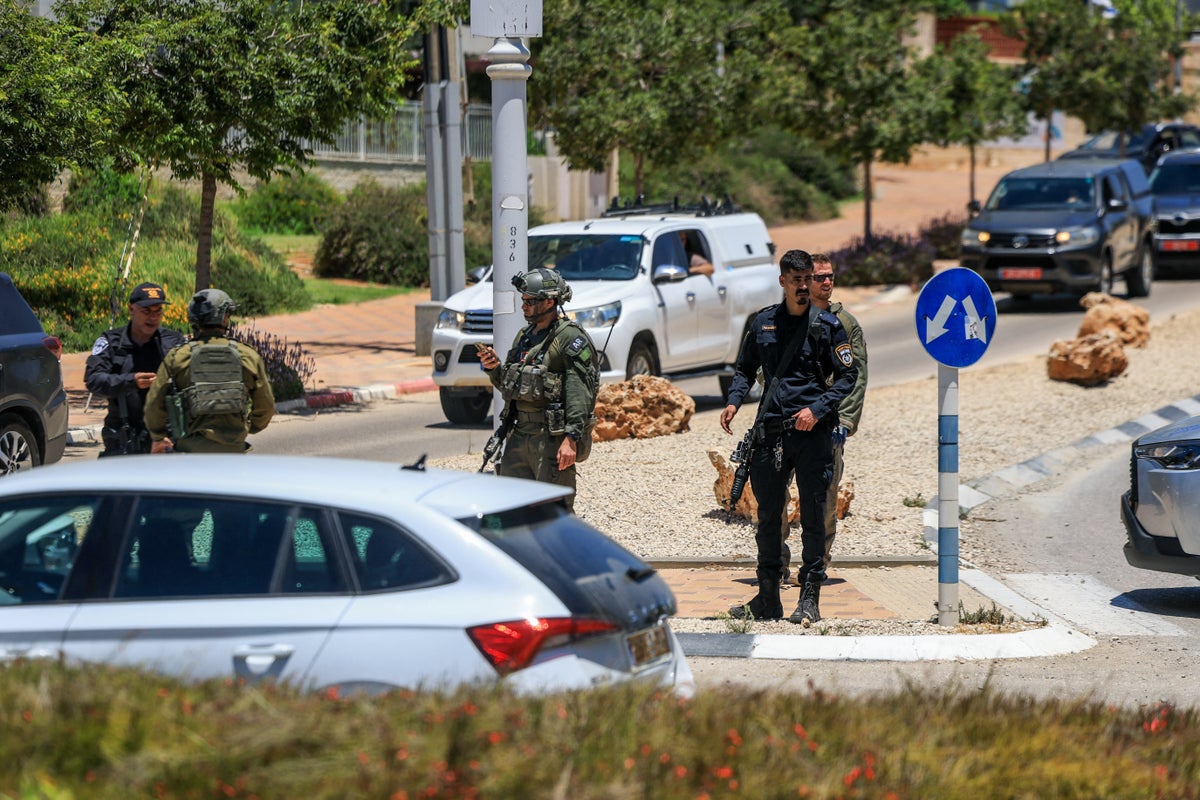
The internal security doctrine of Israel relies on a foundational geographic assumption: the Green Line serves as a kinetic insulation barrier separating hostile West Bank actors from civilian population centers. The multi-vector shooting rampage executed on June 7, 2026, systematically exposed the vulnerability of this insulation. By shifting from a static, single-point engagement to a highly fluid, mobile strike pattern, the assailant maximized confusion, bypassed local defense forces, and exposed a critical systemic blind spot: the operational risk posed by radicalized internal actors holding Israeli citizenship.
Deconstructing this assault requires moving past the conventional media narrative of a localized "drive-by shooting." It must be analyzed through a rigorous tactical framework that examines vector mechanics, geographic vulnerabilities, and the asymmetric advantage of decentralized terror operations.
The Vector Mechanics of a Mobile Spree
The operation succeeded in its initial phase by using spatial velocity to outrun the response loop of local law enforcement. Standard security protocols are optimized for single-point containment. When an incident occurs, response units converge on a fixed coordinate, establishing an outer perimeter to isolate the threat. The June 7 attack broke this containment model by executing a multi-point sequence across at least four distinct geographic nodes within a condensed timeline.
- Node 1 (The Catalyst): The attack commenced at approximately 10:30 a.m. at a gas station near the entrance of Kokhav Yair, an Israeli town positioned immediately adjacent to the West Bank boundary. A gas station represents a high-flow, low-friction transit point, providing both a high density of soft targets and an immediate egress route back to arterial roads.
- Node 2 and 3 (Lateral Displacement): Instead of retreating toward a sanctuary zone, the assailant moved laterally along the border corridor, attacking targets at the entrances of Tzur Natan and Tzur Yitzhak. This lateral movement exploited the delay in regional law enforcement communications. First responders arriving at Node 1 were operating on obsolete spatial data, as the threat vector had already shifted kilometers away.
- Node 4 (The Trans-Border Apex): The sequence extended near the Israeli settlement of Sal'it, located across the boundary line inside the West Bank.
The structural bottleneck exposed here is the velocity differential between a mobile assailant and a bureaucratic command structure. By the time regional commands coordinated across civilian police lines and military sectors, the assailant had already struck multiple targets. The initial assumption of a multi-person, coordinated cellular attack stems directly from this rapid geographic displacement; the command structure misread speed for scale.
The Friction Coefficient of Internal Threats
The operational profile of the perpetrator introduces a severe complication to defensive strategic modeling. Identified as a 20-year-old Palestinian citizen of Israel residing in the nearby Arab city of Tayibe, the assailant possessed blue Israeli identification cards. This legal status fundamentally alters the security calculus by neutralizing the primary defensive layers built by the state over decades.
The West Bank boundary is managed via a physical barrier system, biometric checkpoints, and intelligence-driven profiling. These measures are designed to increase the friction coefficient for an external threat attempting to penetrate the interior. However, an Israeli citizen operates with a zero-friction profile regarding domestic transit. They possess:
- Unrestricted Mobility: The legal right to navigate domestic highways, enter commercial zones, and approach soft targets without triggering structural security alerts.
- Unvetted Logistics: The capacity to acquire vehicles, fuel, and secondary logistical support inside the domestic perimeter without passing through military border checkpoints.
- Surprise Optimization: Defensive forces around borderline towns like Kokhav Yair are structurally oriented outward, anticipating incursions originating from West Bank hubs like Qalqilya. The internal threat vector attacks from the rear, rendering forward-facing defenses obsolete.
The statement by Oshrit Gani Gonen, the regional council head, highlighting that defensive planning since October 7, 2023, focused almost exclusively on cross-border incursions underscores a profound institutional bias. Strategic planners optimized for a high-intensity, external breakthrough while remaining vulnerable to a low-signature internal failure.
The Multi-Weapon and Multi-Actor Framework
While mainstream reports focus on a single gunman, tactical analysis reveals a two-man operational cell utilizing asymmetric escalation techniques. The subsequent apprehension of an accomplice who attempted an assault using a glass bottle indicates a secondary tier of tactical support.
This multi-actor dynamic can be mapped using a simple capability-to-intent matrix:
| Actor Role | Primary Asset | Tactical Objective | Failure Point |
|---|---|---|---|
| Primary Gunman | Small arms, vehicular mobility | Maximum kinetic output, structural disruption, psychological paralysis | Neutralized via pursuit and direct kinetic engagement by police |
| Accomplice / Driver | Operational navigation, proximity support | Logistical facilitation, diversion creation, secondary close-quarters assault | Poor tactical execution; neutralized via non-firearm physical counter-measures |
The deployment of small arms in a vehicular platform yields an incredibly high return on investment for decentralized networks. It requires zero infrastructure, minimal training, and generates disproportionate defensive resource reallocation. Following the incident, large cohorts of the Israel Defense Forces were forced to deploy aerial assets, establish wide-area lockdowns, and confine school children for hours. The cost function of this attack is highly asymmetric: the offensive cell expended minimal capital to freeze an entire regional economic and educational corridor.
Regional Contagion and Strategic Limitations
The June 7 attack cannot be analyzed in isolation from the broader security ecosystem of the West Bank. The escalation of violence in the territory—marked by recent settler operations, high-intensity military raids, and the collateral deaths of non-combatants—serves as an accelerant for individual radicalization curves. While organizations like Hamas praised the operation as "heroic," the lack of an immediate, verifiable claim of responsibility points toward a decentralized execution model.
This decentralized framework poses the ultimate challenge to intelligence agencies like the Shin Bet. Traditional counter-terrorism relies on intercepting communications, tracking financial flows, or monitoring weapon stockpiles within known networks. When an individual with domestic citizenship decides to transition from radicalized intent to kinetic action over a compressed timeline, the intelligence signal-to-noise ratio drops to near zero.
Furthermore, the hardline political response inside Israel highlights the political limitations of current strategic options. Calls for deep structural changes among the Arab citizen population or the implementation of capital punishment for attackers do not resolve the immediate operational vulnerability. Such policies often exacerbate internal friction, increasing the pool of alienated individuals and potentially accelerating the very internal threat vectors they aim to suppress.
The tactical reality of the June 7 rampage demonstrates that as long as the internal-external distinction remains fluid due to geography and citizenship, static defenses will remain insufficient against mobile, decentralized kinetic strikes.
The Breaking News video on the Central Israel Shooting offers live visual context regarding the initial emergency response and deployment of security forces at the Kokhav Yair junction immediately following the multi-point kinetic attack.