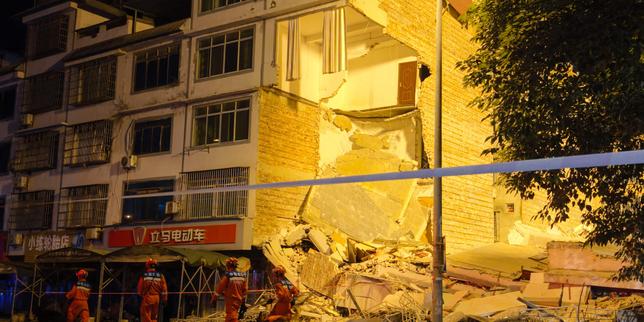
The Alarmist Trap of Seismic Sensationalism
Every time a seismograph needles past 5.0 in East Asia, the international news apparatus triggers a predictable reflex. Headlines scream. Alerts flash. The implied narrative is always the same: imminent catastrophe, structural collapse, and geopolitical instability.
The recent 5.2 magnitude earthquake in China triggered this exact formulaic hysteria. Mainstream outlets rushed out bare-bones reports designed to spark anxiety, leaning on the sheer size of the numbers to drive clicks.
They are selling you raw fear. They are also entirely missing the point.
A 5.2 magnitude event is not a cataclysm. In the architecture of modern seismic engineering, it is a Tuesday. By treating moderate geological adjustments as existential crises, commentators expose their deep ignorance of structural physics and contemporary civil engineering. We need to stop reacting to the Richter scale like terrified onlookers and start understanding how modern infrastructure actually handles kinetic energy.
The Logarithmic Lie: Understanding True Force
The fundamental flaw in public discourse surrounding earthquakes is a basic failure of mathematical literacy. Most people view the Richter scale—or the modern Moment Magnitude Scale ($M_w$)—as linear. They assume a magnitude 5.0 earthquake is just a bit stronger than a 4.0, and a 6.0 is a standard step up.
This misunderstanding creates cheap, sensational journalism.
Seismic magnitude scales are logarithmic. Specifically, each whole number increase on the scale represents a 32-fold increase in radiated energy.
Let us break down the math that the standard newsroom ignores:
- A magnitude 7.2 earthquake—the kind that genuinely flattens unreinforced cities—releases 1,000 times more energy than the 5.2 event currently dominating the news cycle.
- A magnitude 8.2 mega-thrust event releases 32,000 times more energy.
[Magnitude 5.2] -> Baseline Energy (Moderate rattling, localized minor damage)
[Magnitude 6.2] -> 32x Energy
[Magnitude 7.2] -> 1,000x Energy (True structural threat)
When you look at the raw physics, a 5.2 magnitude tremor is a minor thermal venting of the earth. It is an energy release that high-density urban areas are explicitly designed to absorb. Writing a panic-inducing piece about a 5.2 event is the equivalent of writing a front-page exposé on a severe thunderstorm that knocked over a few patio chairs. It confuses routine environmental friction with structural failure.
Redefining the Question: Why Magnitude is the Wrong Metric
The public constantly asks the wrong question: "How big was the earthquake?"
If you want to understand true risk, that question is useless. The metric that actually matters—the one structural engineers obsess over—is Peak Ground Acceleration (PGA), coupled with local building codes.
An earthquake does not kill people. Falling roofs kill people.
I have spent years analyzing structural integrity post-disaster, looking at the grim reality of fractured concrete and sheared rebar. I can tell you with absolute certainty that a low-magnitude quake close to the surface directly beneath a poorly built town is infinitely more dangerous than a massive 7.0 quake buried 50 kilometers deep under a highly engineered metropolis.
China's southwestern and northwestern provinces, which bear the brunt of these seismic shifts, are no longer the vulnerable agrarian landscapes of the mid-20th century. Following the devastation of the 2008 Wenchuan earthquake, the country overhauled its structural mandates.
The Regulatory Shield
The GB 50011-2010 code (Code for Seismic Design of Buildings) shifted the entire manufacturing and construction paradigm. It mandated that even standard residential high-rises must adhere to a strict trinity of defense:
- No Collapse under Rare Earthquakes: The building can take a massive hit, deform permanently, but must remain standing to allow evacuation.
- Repairable under Moderate Earthquakes: Structures experience minor cracking but retain core integrity.
- Undamaged under Small Earthquakes: A 5.2 event falls squarely into this category for modern builds.
When a 5.2 hits a region built under these constraints, the buildings behave exactly as intended. They flex. They dissipate the kinetic shockwaves through ductile detailing and shear walls. The media reports on the tremor; they fail to report on the triumph of the concrete formulation that neutralized it.
The Economics of Resilience vs. The Cost of Hysteria
There is a dark side to our collective obsession with minor seismic events. It distorts risk assessment and misallocates capital.
When the public demands that every single structure in a low-risk zone be retrofitted to withstand a hypothetical 9.0 mega-quake, they are demanding economic suicide. Engineering is a trade-off between probability, cost, and human life.
"To engineer everything to a flawless, zero-risk standard means building nothing at all. Perfect safety is a luxury that bankrupts civilizations."
If we look honestly at the data, the return on investment for over-engineering structures against moderate tremors is deeply negative. The focus belongs on critical infrastructure: power grids, water treatment facilities, and transport arteries.
During a 5.2 event, the real threat is rarely structural collapse. The threat is secondary systemic failures. Did the automated valves shut off the natural gas lines to prevent fires? Did the high-speed rail lines automatically trigger their braking systems via early warning networks?
In modern China, the answer to these questions is increasingly automated. The integration of the national early warning system uses the speed of light—radio waves warning cities seconds before the slower seismic S-waves arrive. This tech-driven resilience is the real story, yet it gets buried beneath sensationalist imagery of cracked plaster.
Dismantling the Consensus
Let us address the standard talking points found in typical news coverage of these events:
"The local economy will face severe disruption."
This is a fundamental misunderstanding of localized supply chains. Modern industrial hubs are built with redundant power loops and modular manufacturing setups. A minor tremor might halt a production line for two hours while calibration checks occur. It does not break a global supply chain. The panic causes more market volatility than the physical shaking.
"This is a precursor to a much larger, catastrophic event."
Seismology cannot predict earthquakes. Anyone claiming a 5.2 is a definitive "foreshock" for an imminent 8.0 is selling pseudoscience. It could just as easily be an isolated release of stress, or the tail end of an older sequence. Treating every minor quake as a prophetic warning sign is a psychological exhaustion tactic that breeds public apathy.
"Older structures prove the entire region is vulnerable."
This argument relies on cherry-picked data. Outliers exist. Yes, an unreinforced brick barn built in 1974 will suffer damage during a 5.2 quake. But using a dilapidated, rural structure to generalize the vulnerability of an entire modern province is deceptive journalism. It deliberately misrepresents the baseline reality of modern housing stock.
The Cold Reality of Seismic Coexistence
Living on a tectonically active planet means accepting that the ground moves. The goal of civilization is not to stop the earth from shaking; it is to build structures that render that movement irrelevant.
When we look at the reality of the 5.2 magnitude earthquake in China, we see a system working exactly as designed. The earth shifted. The sensors flagged the movement. The buildings flexed. The population went back to work.
Stop swallowing the sensationalist narratives peddled by outlets desperate for your attention. A 5.2 magnitude earthquake isn't a sign of an impending apocalypse. It is merely a validation of modern engineering, proving that we have successfully designed our way out of fear.
The earth shook, and the concrete didn’t care.