The smell of toasted rain rises from the asphalt of a third-floor flat in south London. Inside, the kettle clicks off. A tiny green LED on a sleek rectangular panel leaning against the balcony railing blinks once. Twice.
Three hundred miles north, a gas turbine slows down by a fraction of a rotation.
Nobody celebrates. Nobody signs a treaty. But right here, right now, a tenant who does not own a single square foot of soil has just hijacked her own utility bill.
For decades, generating your own electricity carried a class signifier. You needed a detached roof, thousands of pounds in scaffolding, an obliging landlord, and a five-year horizon of bureaucratic patience. Solar power belonged to the suburban homeowner. It belonged to the lucky. If you lived in a Victorian conversion apartment, a council estate, or a rented Victorian terrace with a crumbling chimney, renewable energy was a spectator sport. You watched others lower their carbon footprints while your meter spun in place, eating your wages month after month.
Then came the plug.
The Hardware Rebellion
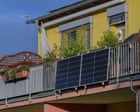
Let us be entirely practical for a moment. This is a plug-in balcony solar panel system, often known across the European continent as a Balkonkraftwerk. (Note: When I refer to the hardware mechanics, I am describing standard commercially available plug-and-play kits entering the British market).
The physics are almost scandalously simple. You take a photovoltaic panel—weighing around twenty kilograms, roughly the size of a large flat-screen television—and mount it to your balcony railing or prop it on a flat roof. You run a heavy-duty cable from the panel into a microinverter. And from that inverter, a standard electrical cord runs straight into an ordinary indoor wall socket.
No electrician required. No permits from the local council. No rewiring the fuse box.
Electricity flows from the sun, hits the silicon, converts to direct current, gets flipped into alternating current by the microinverter, and travels backward through your wall plug to feed whatever is hungry in your flat right now. Your refrigerator. Your Wi-Fi router. Your standby television.
Physics does not care who holds the deeds to the building. Electrons flow toward the path of least resistance. When your balcony panel generates two hundred watts of power on a brisk Tuesday afternoon, your home draws that power first, before pulling a single watt from the national grid.
Your spinning meter slows down. Sometimes, if the flat is empty and the sun is high, it stops entirely.
The Renters' Ghost
Let us talk about Arthur. Arthur is a hypothetical renter, though he represents roughly forty percent of the housing market in modern Britain. Arthur lives in a cramped flat in Bristol with north-facing windows and a tiny Juliet balcony that catches four hours of weak afternoon sun.
Arthur’s landlord is a faceless property management firm based in the Cayman Islands. If Arthur writes to them asking to install a four-thousand-pound roof array, the reply will be a polite silence followed by a Section 21 eviction notice for creating a liability hazard.
Arthur’s problem is not a lack of desire to save the planet. His problem is transience. He moves every two years. He lives at the mercy of landlords who treat energy efficiency as someone else's problem.
For years, the green transition treated people like Arthur as collateral damage. We lectured them about changing their lightbulbs while utility bills climbed past the cost of groceries. We told them to turn down their thermostats while heating leaked through single-pane sash windows they were legally forbidden to replace.
The plug-in balcony kit changes the psychological geography of tenancy.
Imagine Arthur unboxing his kit on a Saturday morning. It arrives in two flat-pack cardboard boxes, delivered by a standard courier. He spends forty minutes tightening brackets with an Allen wrench. He hoists the panel over the metal railing, secures the safety tether, and plugs the cord into the socket behind his sofa.
He is no longer a passive consumer waiting to be billed. He is a producer.
The Regulatory Wall
Of course, the British bureaucracy looked at this simple act of self-reliance with profound suspicion.
For years, the United Kingdom lagged far behind Germany, Austria, and Switzerland, where millions of balcony power plants hum quietly away on apartment blocks in Berlin and Vienna. British regulations were built for industrial-scale solar farms and massive rooftop installations. The Distribution Network Operators—the regional monopolies that manage the local power lines—worried about what they called "backfeeding."
What happens, the engineers asked with furrowed brows, if millions of people plug solar panels into ordinary wall sockets? Will the circuits overheat? Will unsuspecting handymen working on local power lines get shocked?
These are legitimate safety concerns, wrapped in layers of institutional inertia. But the European experience proved something vital: standard microinverters are smart. The moment the grid loses power, the microinverter shuts down instantly. It cannot pump electricity into a dead line. Furthermore, plugging a modest three-hundred-watt or eight-hundred-watt panel into a household circuit draws no more current than a high-end coffee maker.
Safety standards evolved. Certification bodies caught up. And now, for the first time, these kits are hitting the mainstream British market legally, cleanly, and without requiring a master’s degree in electrical engineering to install.
The Economics of Small Things
Let us look at the numbers, stripped of marketing hype.
A standard balcony solar setup costs anywhere from three hundred to six hundred pounds. On a typical British balcony—plagued as we are by clouds, maritime weather, and moody skies—a single 400-watt panel can realistically generate around 300 to 350 kilowatt-hours of electricity per year.
At current UK energy price caps, that translates to roughly one hundred pounds shaved off an annual electricity bill.
If you do the crude math, the payback period sits between three and five years. After that, the electricity is pure profit. The panel itself carries a performance warranty of twenty-five years.
Critics sneer at these numbers. One hundred pounds a year? they ask. That is barely a drop in the ocean. That does not pay for a tank of petrol or a week of groceries.
They are missing the entire point.
For a household living on the edge of fuel poverty, one hundred pounds is the difference between turning on the radiator in November and wearing a heavy coat indoors. More importantly, it represents a psychological shift. It is the restoration of agency. When you watch your digital power monitor show zero consumption while the sun beats down on your balcony, you feel something unfamiliar in the modern economy: control.
The Architecture of Tomorrow
Walk through any major European city today, and you will see them. They look like dark, silent wings perched on concrete ledges, angled toward the light. They are architectural barnacles, reclaiming dead vertical space for human survival.
They do not require vast tracts of farmland. They do not trigger local planning battles over rural aesthetics. They use the surfaces we already built—concrete balconies, brick walls, flat garage roofs—and turn them into silent power plants.
Back in south London, the kettle clicks off again. The afternoon light shifts, cutting a sharp gold line across the hardwood floor. Outside, the panel hums its silent, invisible work, feeding the room, defying the landlord, ignoring the bureaucrats, and taking back a tiny piece of the sky.