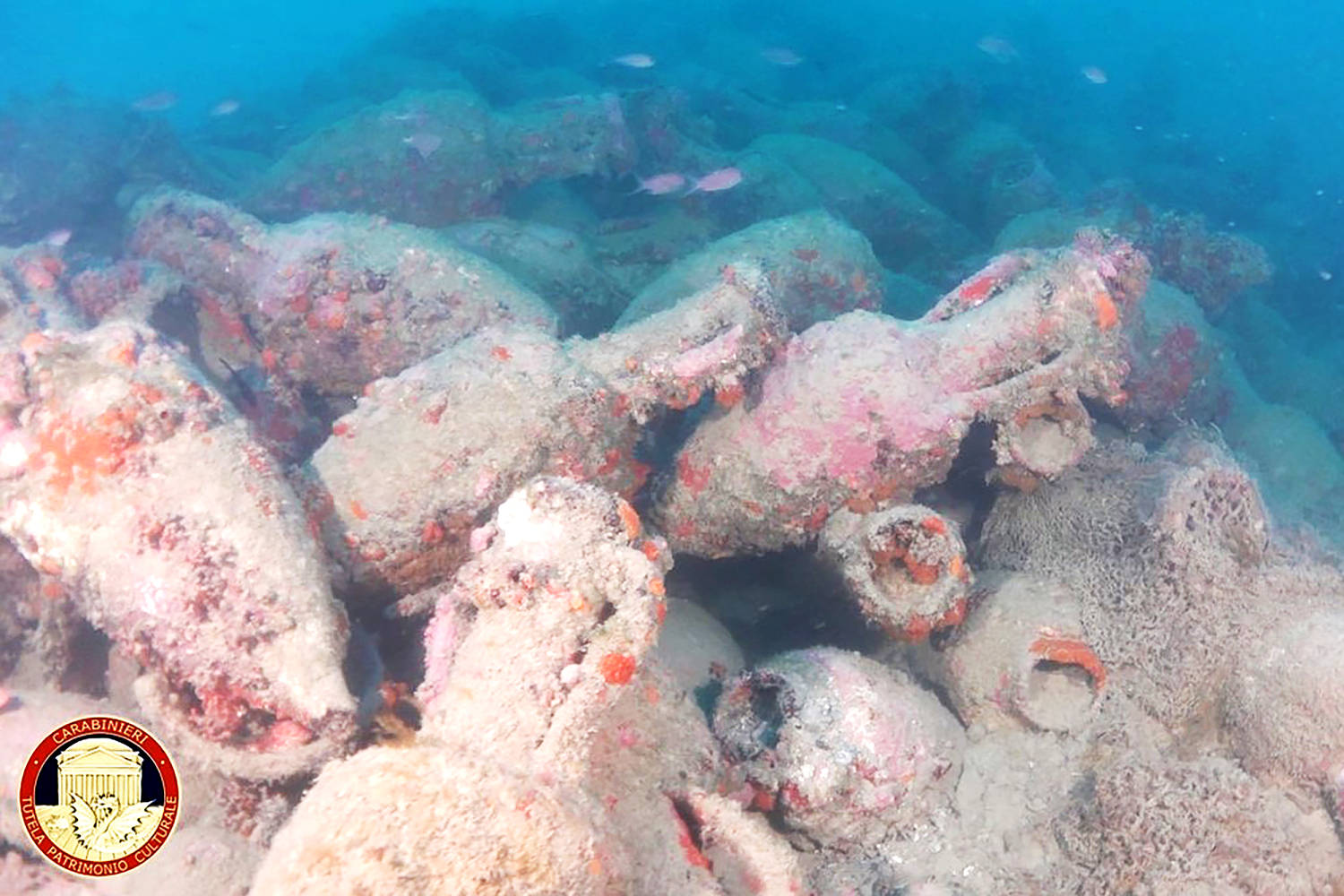
A fisherman's casual glance at an underwater scanner off the coast of Sicily just rewritten a chapter of ancient history. What looked like a mundane rock formation on a screen turned out to be an intact 2,100-year-old Roman merchant vessel resting 46 meters below the surface.
Italy's culture minister, Alessandro Giuli, wasted no time calling it one of the most important underwater archaeological finds in recent memory. Packed tightly with roughly 500 ancient amphorae, this vessel gives us a direct, undisturbed look at the maritime logistics that once bound the classical world together.
If you think underwater archaeology is just dusty plates and broken pottery, this discovery proves you wrong. It's a pristine time capsule sitting quietly on the Mediterranean floor.
Inside the Mazara del Vallo Wreck
The ship rests about three miles off the coast of Mazara del Vallo. It measures roughly 21 meters long and 6 meters wide. That makes it a standard-sized commercial cargo carrier of the late Republic era, dating somewhere between the second and first centuries BC.
When professional divers from Italy's Carabinieri cultural heritage protection squad descended to investigate following the fisherman's tip-off, they found an astonishing scene. Diver Giacomo De Mola noted that low visibility cleared just enough to reveal a vast, silent expanse of pottery.
The cargo consists primarily of Dressel 1A type amphorae. These are tall, two-handled ceramic jars with narrow necks built specifically for long-distance transport.
- The Cargo: Roughly 500 ceramic jars.
- The Content: Primarily high-grade ancient wine.
- The Depth: 46 meters down, protecting it from modern surface trawlers.
Why Dressel 1A Amphorae Matter
Archaeologists don't just get excited over old jars because they look cool in museums. These containers act like ancient barcodes.
Dressel 1A amphorae are thick-walled and heavy, designed to withstand the violent motion of cargo holds on choppy seas. By analyzing the clay composition and residual organic compounds trapped inside the ceramic pores, researchers can pinpoint where the wine was produced and trace its exact export path.
This specific shipment maps out the economic arteries connecting mainland Italy to regional ports. It proves how aggressively commercialized the Mediterranean economy was two millennia ago. Wine wasn't just a local luxury; it was a massive, industrialized export business.
The Threat of Looting and the Race for Preservation
Underwater heritage sites face constant danger. Black-market antiquities dealers view sites like this as open vaults.
That explains why Sicilian authorities and specialized police units moved quickly to secure the coordinates once the find was verified. Looters have plundered countless wrecks across the Mediterranean over the decades, stripping ceramic jars from their context and destroying the historical data locked in the seabed layout.
The Sicily Superintendency of the Sea is planning a meticulous excavation and documentation phase. Divers and underwater robots will map every square centimeter of the hull before any extraction occurs.
What Comes Next for the Sicilian Wreck
Recovering a wooden hull that has spent twenty centuries underwater is a delicate engineering nightmare. Wood degrades rapidly when exposed to oxygen and changing currents.
Conservators will need to stabilize the remaining structure using specialized chemical treatments if they plan to raise any portion of the ship itself. For now, the focus remains on mapping the site and safeguarding the remaining amphorae from illicit divers.
The Mediterranean still holds thousands of undiscovered hulls beneath its blue surface. Every time a fisherman spots an odd shape on a sonar screen, we stand to learn a little more about the mariners who risked everything to sail an empire's cargo across the sea.