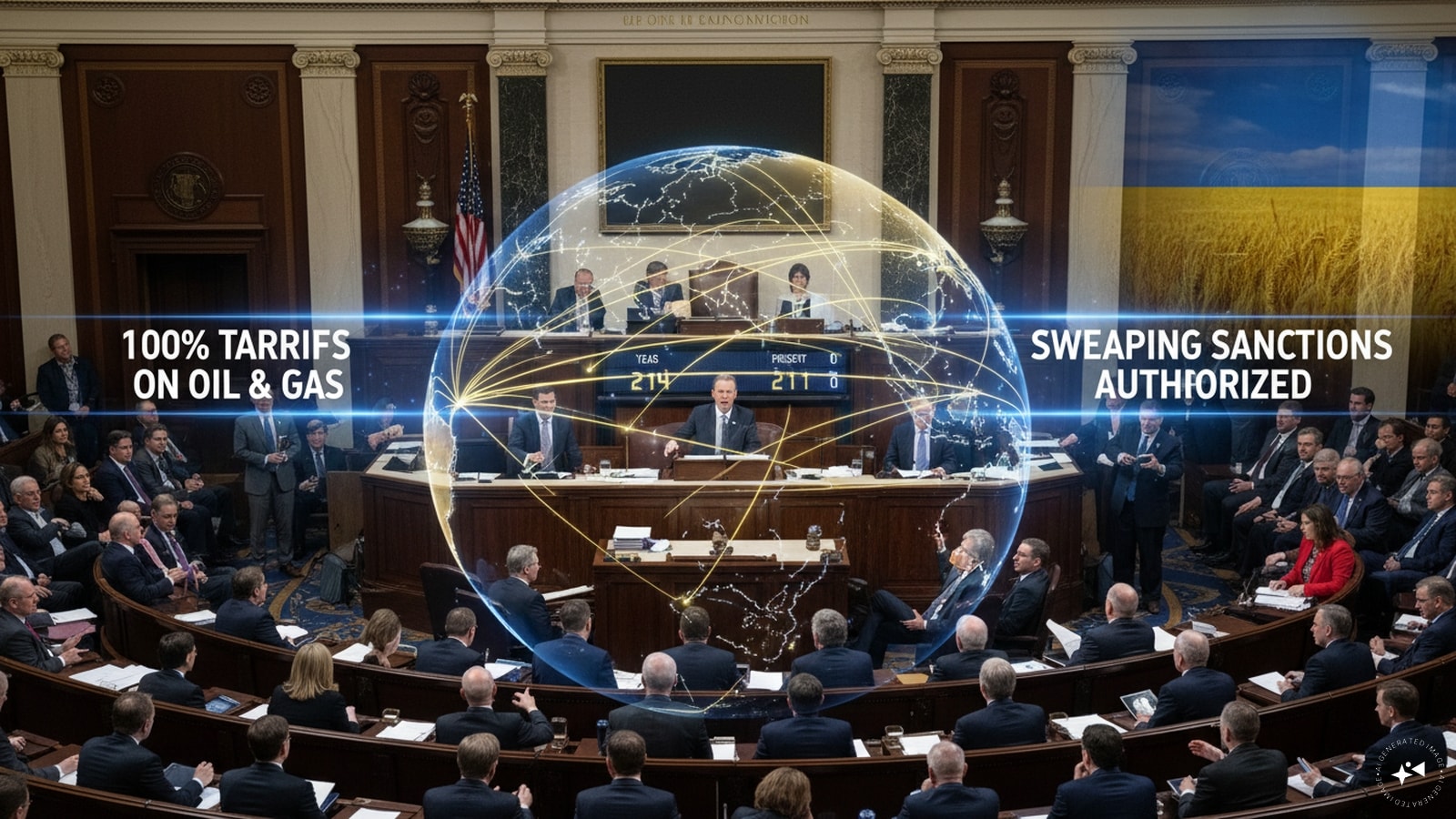
The legislative machinery in Washington operates on a distinct rhythm of symbolism and economic coercion. When the United States House of Representatives advanced the Lindsey O. Graham Sanctioning Russia and Iran Act, the immediate headline focused on the headline-grabbing threat of 100% secondary tariffs targeting major buyers of Russian crude. India, alongside other heavy importers, found itself thrust directly into the legislative crosshairs. Yet, looking past the blunt instrument of congressional posturing reveals a complex web of diplomatic leverage, energy pragmatism, and the harsh realities of modern supply chain economics.
The statute itself is designed to squeeze Moscow's war chest by penalizing the world's top five buyers of Russian petroleum products if they maintain procurement past a mandated window. For New Delhi, this is not a theoretical abstraction. India's refining sector absorbed unprecedented volumes of discounted Urals grade crude following the redrawing of global energy routes after 2022.
Domestic energy security dictates foreign policy choices in South Asia, not Washington's electoral calculus. Indian officials have repeatedly underscored that their procurement decisions are anchored entirely in market dynamics and the imperative to insulate domestic consumers from inflationary shocks. When Brent crude fluctuates violently under the pressure of Middle Eastern conflicts or supply constraints, turning away from discounted barrels is simply not an option for an economy expanding at New Delhi's pace.
The friction between Washington and New Delhi highlights an underlying contradiction in American trade policy. On one hand, the United States seeks a strategic counterweight in the Indo-Pacific to manage regional power shifts. On the other hand, domestic lawmakers frequently deploy punitive tariff mechanisms that treat sovereign partners as subordinate entities. The legislative text grants the executive branch discretionary authority to wield these penalties, but the execution of such power carries severe systemic blowback. Imposing prohibitive duties on Indian manufactured goods and exports would inevitably spark retaliatory friction, disrupting delicate bilateral trade frameworks that took years to construct.
Behind closed doors, trade negotiators have danced around an elusive interim agreement. Proposals to lower baseline trade barriers have repeatedly stalled as judicial interventions and political posturing disrupted the timeline. By introducing the threat of maximum tariffs into an already volatile ecosystem, Congress has complicated the path forward.
Markets despise uncertainty, and energy traders pricing long-term charters are already factoring in the geopolitical risk premium. Refineries on the Jamnagar coast cannot pivot overnight away from established feedstock without facing crippling cost spikes. The assumption that secondary sanctions can cleanly sever complex commodity flows without breaking downstream markets misunderstands how deeply integrated global trade has become.
Sanctions legislation often functions more as a political signaling device than an enforceable economic blockade. The structural realities of global energy flows dictate that oil cannot simply be wished out of existence; it merely shifts through intermediary traders, shadow tankers, and blended ship-to-ship transfers. Pushing major developing economies away from transparent bilateral trade and into opaque alternative payment structures ultimately undermines the very transparency Washington claims to champion.
The standoff over Russian crude exposes the limits of unilateral economic dominance in a multipolar commodity market. New Delhi has made it clear that its strategic autonomy is non-negotiable. Washington is discovering that the cost of enforcing global compliance through tariff walls is steep enough to strain alliances built for the long haul.