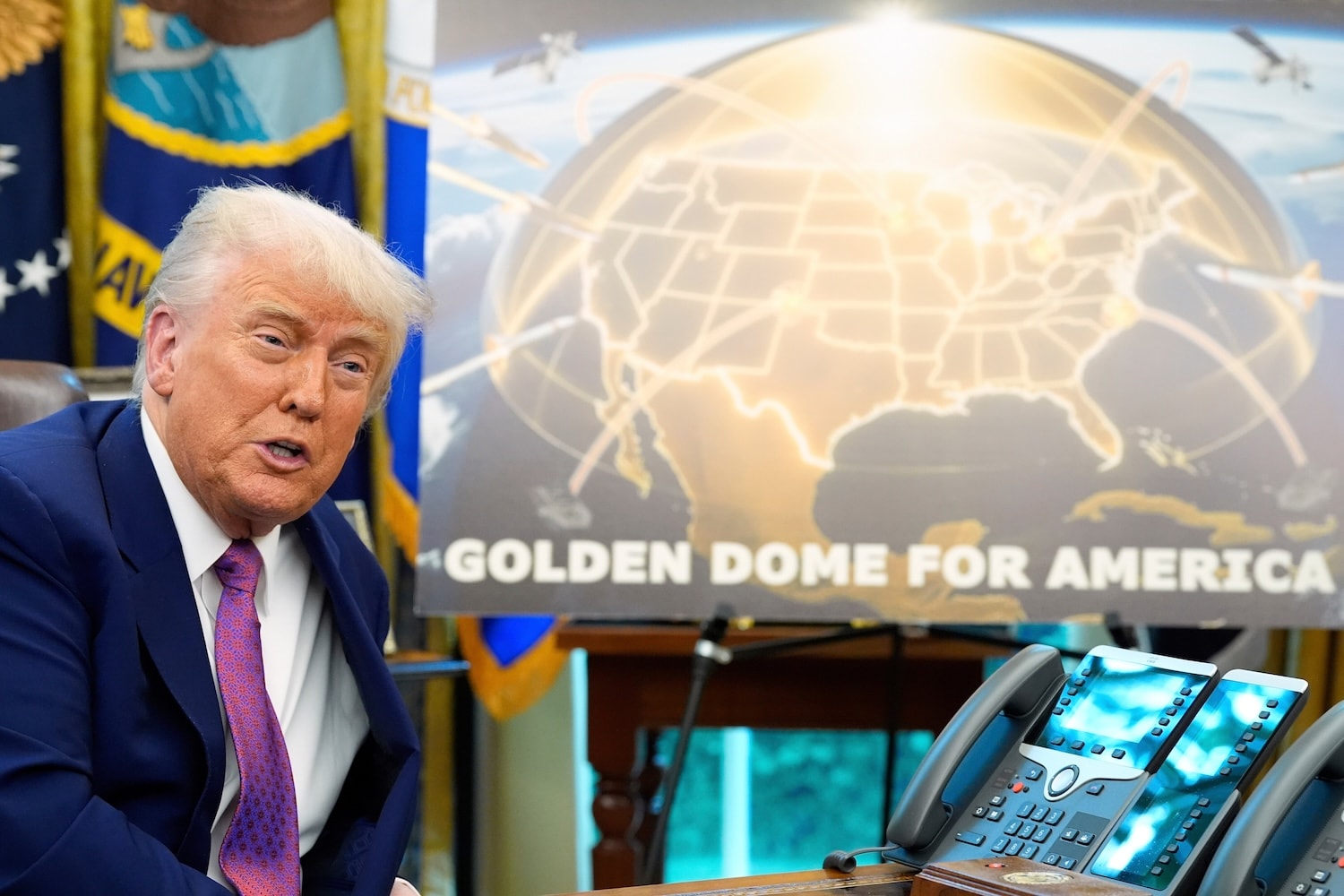
The media is choking on a number: $1.2 trillion. They look at the price tag for a national "Golden Dome" missile defense system and see a fiscal apocalypse. They call it a boondoggle. They cite the spiraling costs of the F-35 or the Littoral Combat Ship as proof that big defense hardware is where tax dollars go to die.
They are looking at the wrong ledger.
When pundits scream about the "trillion-dollar shield," they treat national defense like a consumer purchase—a line item to be haggled over at a dealership. This isn't a car. It’s an insurance policy for the continued existence of the American economy. If you think $1.2 trillion is expensive, try calculating the GDP of a smoldering crater.
The "lazy consensus" ignores the fundamental shift in warfare. We are entering an era of "cheap lethality," where $50,000 drones and mid-tier ballistic missiles can paralyze a superpower. The Golden Dome isn't about vanity; it’s about ending the era where a rogue actor can hold the global financial engine hostage for the price of a used Honda Civic.
The Math of Kinetic Asymmetry
Critics love to talk about the "cost-exchange ratio." This is the favorite metric of the spreadsheet warriors. They argue that if an interceptor missile costs $2 million and the incoming threat costs $100,000, the defense is "losing."
This logic is bankrupt.
In a kinetic engagement, the cost of the interceptor is irrelevant. The only math that matters is the Value of the Asset Protected (VAP) versus the Cost of the Interceptor (CI).
Imagine a scenario where a $3 million interceptor stops a $200,000 missile headed for a semiconductor fabrication plant in Arizona or a liquid natural gas terminal in Louisiana. That plant represents $20 billion in capital investment and $100 billion in downstream economic activity.
The "loss" isn't $2.8 million. The "gain" is the preservation of a $100 billion economic pillar. When you scale this across the entire United States, a $1.2 trillion investment to protect a $25 trillion annual GDP is a premium of less than 5%. Show me a hedge fund that wouldn't take those odds to insure a volatile asset.
Killing the Star Wars Ghost
The biggest hurdle for the Golden Dome isn't physics; it’s nostalgia. Every time a national shield is mentioned, the ghosts of the 1980s "Strategic Defense Initiative" (SDI) crawl out of the woodwork. Critics point to the failures of the past to dismiss the tech of the present.
That is a tactical error.
The SDI era failed because of two things: computing power and sensor fusion. In 1983, we were trying to hit a bullet with a bullet using the processing power of a graphing calculator. Today, we are playing a different game.
We now have:
- Distributed Aperture Systems: Sensors that talk to each other across platforms, creating a persistent "God view" of the battlespace.
- Hypersonic Tracking: We aren't just looking for slow-moving arcs; we are tracking objects moving at Mach 5+ using infrared search and track (IRST) arrays that didn't exist ten years ago.
- Directed Energy: The cost-per-shot for high-energy lasers is measured in dollars, not millions.
The Golden Dome isn't a single "dome." It’s a layered mesh. It starts with space-based architecture—the Proliferated Warfighter Space Architecture (PWSA)—and moves down to ground-based midcourse defense.
Why the "Initial Estimate" Always Lies
The competitor article wrings its hands over the fact that the cost is "far above the initial estimate."
Welcome to aerospace.
Initial estimates in defense contracting are theater. They are designed to get a program through the initial "Valley of Death" in subcommittee hearings. But here is the secret the industry won't tell you: the cost overruns are often a byproduct of capability creep, which is actually a good thing.
As the threat profile evolves—moving from simple ICBMs to maneuverable hypersonic glide vehicles (HGVs)—the system requirements must shift. If the price stayed at the "initial estimate," it would mean we were building a shield for yesterday's war. A $1.2 trillion system that works is infinitely cheaper than a $500 billion system that misses.
The Deterrence Dividend
There is a hidden ROI (Return on Investment) that no one mentions: the Deterrence Dividend.
The primary goal of a Golden Dome isn't actually to shoot down missiles. It is to make the act of firing them so mathematically futile that the adversary never presses the button. This is "Cost Imposition."
When an adversary knows their $500 million salvo has a 99% chance of being neutralized before it hits dirt, that $500 million becomes a wasted investment. We force them to spend their limited resources on increasingly complex, expensive, and fragile delivery systems just to maintain the status quo.
We aren't just buying a shield; we are buying the bankruptcy of our enemies.
The Real Risks: Complexity and Monocultures
I won't tell you it’s all sunshine. The risk isn't the price—it’s the architecture.
The danger of a $1.2 trillion program is the "Monoculture of Defense." If we hand the entire contract to one or two "Prime" contractors, we get a rigid, slow-moving system. To make the Golden Dome work, it must be built on Open Architecture.
We need:
- Software-Defined Defense: The hardware (the launchers) should stay the same, while the targeting algorithms are updated weekly, not every decade.
- Agnostic Interceptors: The system must be able to fire a Raytheon missile, a Lockheed interceptor, or a startup’s kinetic kill vehicle using the same sensor data.
- Redundancy: A dome that relies on a single "brain" is a dome with a single point of failure.
Addressing the "People Also Ask" Nonsense
"Can a missile shield really stop everything?"
No. And it doesn't have to. This is the "Perfection Fallacy." If a shield stops 90% of a concentrated attack, it preserves the ability of the nation to retaliate. It turns a "knockout blow" into a "bloody nose." In the world of nuclear or high-end conventional statecraft, that difference is the gap between a ceasefire and total extinction.
"Isn't this just a handout to defense contractors?"
Partially, yes. The military-industrial complex is a beast that needs feeding. But that’s a political problem, not a strategic one. You don't leave your front door unlocked just because you don't like the guy who sells security systems. You buy the system and then audit the hell out of the contractor.
"Won't this trigger an arms race?"
The arms race is already happening. China is testing HGVs. Russia is deploying the Avangard. North Korea is launching more frequently than a Florida SpaceX pad. To suggest that building a shield is the provocation is like saying wearing a bulletproof vest is what causes people to shoot at you.
The Sovereignty of Certainty
We are currently living in a state of "Strategic Vulnerability." We rely on the sanity of our adversaries. We hope that the threat of Mutually Assured Destruction (MAD) holds firm.
But MAD is a psychological construct. A Golden Dome is a physical reality.
$1.2 trillion is the price of moving from a world where we "hope they don't" to a world where we "know they can't." It is the price of ensuring that the American century doesn't end because of a single sensor error or a dictator’s bad day.
Stop looking at the cost. Start looking at the stakes. If we don't build it, the eventual cost won't be measured in dollars—it will be measured in zip codes.